
Endo Belly Series Part 3: Poor Digestion and Abdominal Bloating
Let me tell you something about endometriosis that really knocked me sideways when I first understood it—this chronic condition that affects millions of us women isn't just misunderstood, it's been completely minimized. What we're dealing with is the growth of endometrial-like tissue outside our uterus, and it leads to a whole range of symptoms that can absolutely turn your world upside down. It did my own world for nearly a decade (why I'm now such a passionate crusader about endo research).
Among the most challenging and visible of these is something we call endo belly—and if you've experienced it, you know exactly what I'm talking about. It's that severe bloating and abdominal distension that can make your stomach look and feel dramatically swollen. You may have severe stomach pain with it, and sometimes it happens a few hours after eating or at certain points in your menstrual cycle, leaving you wondering what the heck just happened to your body.
So many of us with endometriosis experience not only that crushing pelvic pain and those heavy periods, but also this uncomfortable, tight, and sometimes painful swelling in our abdominal region. The sensation can range from mild discomfort to severe bloating that makes it impossible to button your jeans or go about your day without feeling like your body is betraying you.
Here's what I want you to understand: endo belly isn't just about looking bloated—it's so much more complex than that. This symptom can be triggered by SO MANY THINGS: hormonal fluctuations, digestive issues, SIBO, core dysfunction, stress, and more, creating a perfect storm in your body.
But here's the hopeful bit: understanding the connection between endometriosis and digestive issues is a crucial step in learning how to manage and reduce these endo belly symptoms! You can reclaim your comfort and confidence—I've seen it happen, and I believe it's possible for you too.
INTRODUCTION TO DIGESTIVE INSUFFICIENCY AND ENDO BELLY Symptoms
Third in my series on endo belly, I’m excited to talk about one issue that is relatively easy to address: digestive insufficiency! A fancy way of saying your body has trouble digesting (literally breaking down the foods you eat and assimilating them), and that poor digestive function is contributing to gas being produced, bacteria being fed, water being drawn into the bowel, and yes – endo belly symptoms.
Do you suffer from poor digestion? Let's ask some questions: After you eat do you feel like a lump of coal has hit your insides and won’t move? Do you often feel uncomfortably full? Do you have heartburn, gastritis, or acid reflux? Does your stool have partially digested food in it? Do you have a hard time salivating? And, yes, do you bloat big after meals? Meet some classic symptoms of poor digestion, and boy, can this make you bloat like a balloon.
This was a big reason for some of my own endo belly bloat, and from working with clients, I can tell you it’s almost guaranteed it’s going to be an important part of addressing your own endo belly bloat.
That's why, today, we’re going to talk about one endo-belly connection of many: the endometriosis-digestive dysfunction connection. It’s one of many factors to consider when dealing with endo belly because the truth is, endo belly can be caused by many different things! It’s why I wrote this series for you! We will uncover the 6 big (like, endo belly big) factors that may be behind many of our endo bellies. Your endo belly may be provoked by one, two, three, or, well, all of them :) Check out any of these links for more info:
Lesions, Inflammation, and endo belly
For today, let’s chat about digestive insufficiency as a big culprit for endo belly misery.
WHAT IS DIGESTION AND HOW IS IT RELATED TO ENDOMETRIOSIS BELLY
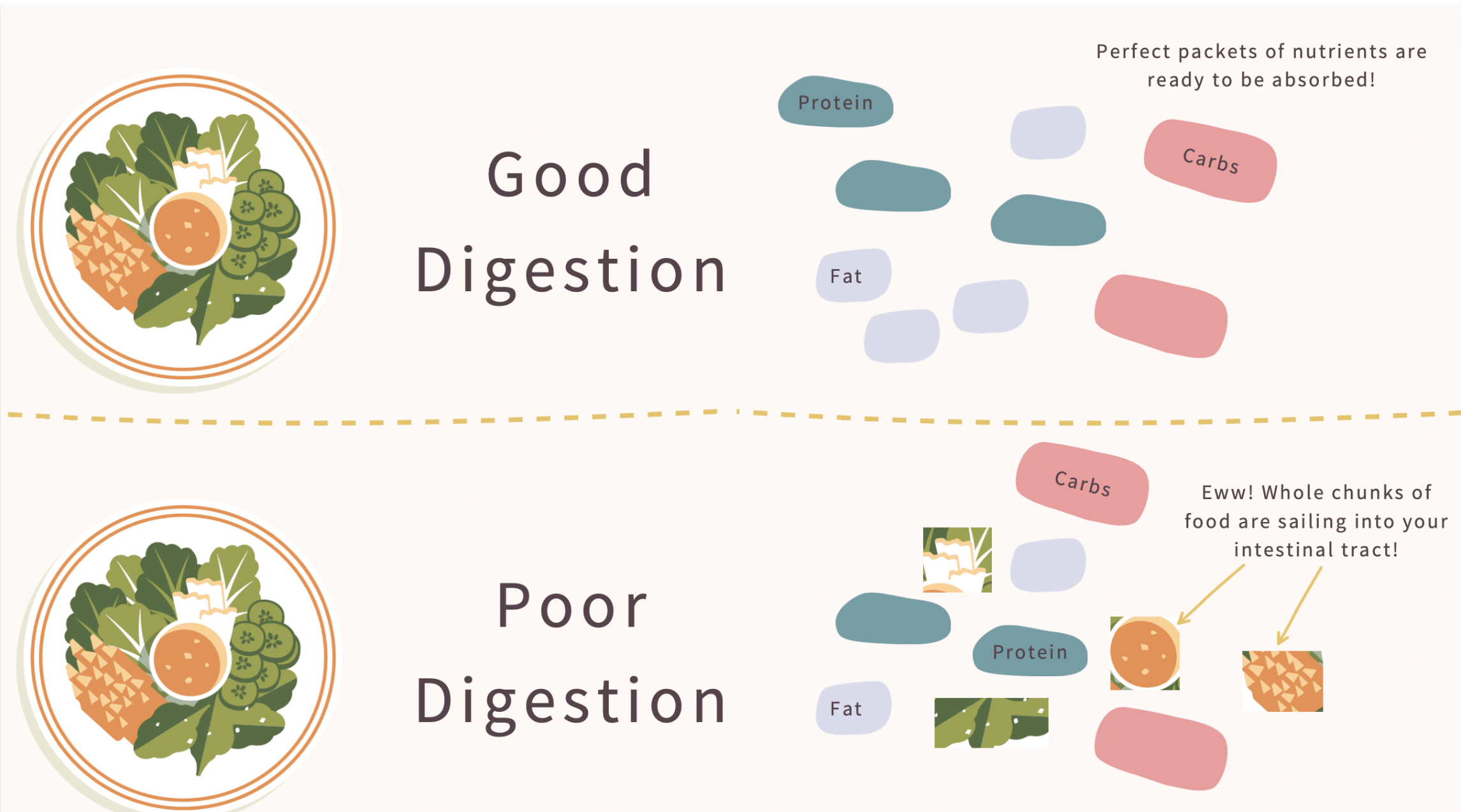
Digestion is the process that breaks down proteins, fats, and carbohydrates into teeny tiny particles that can be absorbedin your intestinal tract. Fat is broken down to fatty acids, proteins into amino acids, and carbohydrates into sugars fibers.
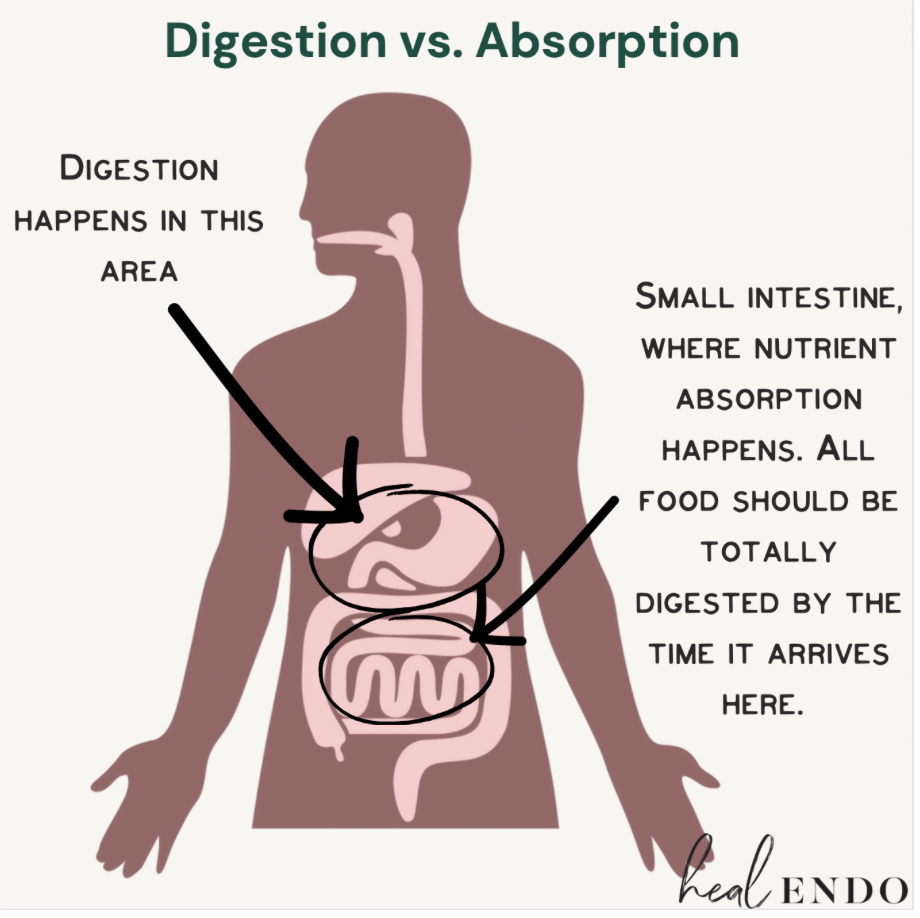
Without digestion, there is no absorption, where your body gobbles up those tiny little nutritional packages. Proper digestion is also essential for supporting gut health, which plays a key role in reducing bloating and discomfort.
The magic of turning food into microscopic bits before it gets to the small intestine is a five-step process we take for granted. Let’s learn about the four steps that are needed (so we can see if all of yours are working).
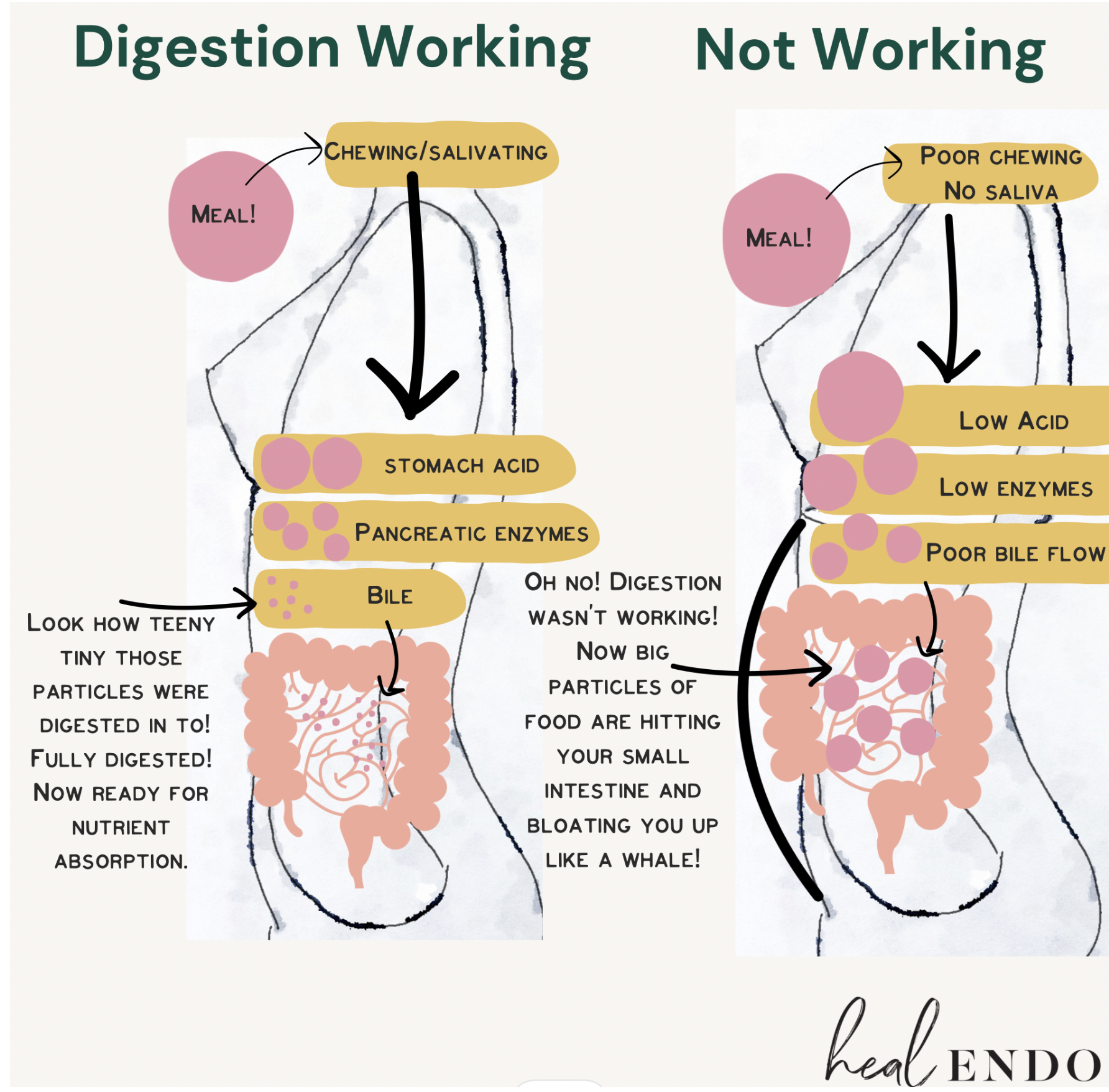
Digestion starts in the mouth! First there’s grinding to a pulp, which takes the heavy lifting off your other organs. If you see big pieces of food in your stool, blame a lazy mouth before anything else. Second, saliva has a digestive enzyme called salivary amylase, which is crucial for breaking down carbohydrates. If you’re not salivating, your carbs will become a bloating feast for wanton bacteria below. Last, chewing/salivating is essential for mental signaling. When you tune in to your meal with taste, relaxation, and saliva, you signal to the digestive organs below to “start their engines.” That’s why the simple act of chewing well is so crucial (and why when you eat a meal fast and without tasting it, you feel like a brick has landed in your tummy and zero digestion is occurring).
Next comes the stomach, whose primary role is breaking down animal proteins, cleaving minerals, and disinfecting pathogens with all that acid. Your stomach is an acidic organ, and it’s supposed to be! Think of that cyborg in Terminator melting into molten metal. This is what your stomach does to your food.
On entrance to your small intestine, this food-goo is hit by a wave of pancreatic digestive enzymes to break everything down even more! You know those expensive digestive enzymes you buy at the store? Yah, your pancreas makes those. It also releases sodium bicarbonate (like baking soda) to neutralize all that acid from your stomach so it doesn’t burn your other parts.
Up next, the gallbladder releases bile, your fat emulsifier. Without proper bile levels, you won’t be digesting or absorbing your fats very well.
Lastly, the lining of your small intestine (called the brush border) produces enzymes that further break down carbohydrates.
There you have it! Your protein, fats, and carbs are now broken down into teeny tiny pieces, ready to be absorbed for the remainder of the small intestine.
WHY DIGESTIVE INSUFFICIENCY CAUSES SEVERE BLOATING AND ENDO BELLY
Digestive inefficiency means that anything along this chain of digestion (breaking down the big macronutrients) has gone wrong. Perhaps there is too little stomach acid, thanks to something like stress or an impaired stomach lining (like I had from taking too much ibuprofen, oops!), preventing proteins from breaking down. It could be that your gallbladder isn’t performing optimally, so you’re not breaking down fats. Or maybe you’re not chewing or salivating, essential for starting to break down carbohydrates, so those are flowing whole through your intestinal tract. Perhaps you have gut dysbiosis that damaged the lining of your small intestine and now your carbs are fully broken down.
This is digestive insufficiency, and it can cause a number of issues, from contributing to malnutrition (your body can’t absorb nutrients if they’re not broken down) to leaky gut (due to the inflammation produced). For the sake of this article, there are two specific things that can really increase endo belly bloating specifically:
1) Fermentation: Large particles or fat, protein, or carbs aren’t meant to flow through a 98-degree, moist tube for days. If they do, they can ferment or putrefy in your intestines. Imagine a blender where you blend up a meal and leave it in the blender for 48 hours in a 98-degree room with the lid tightly on. Do you know what will happen? It will expand so much that it will blow the lid off and maybe even get some bits on the floors, counters, and ceiling! Severe swelling and painful bloating are prominent symptoms that can result, often causing significant abdominal distension and discomfort.
Can you now start to see what the same meal would be doing inside you? [insert bloated belly]
2) Contribute to dysbiosis: Undigestible food can also feed the wrong types of bacteria, which produce gases that bloat you. Recent clinical data from 2025 have confirmed a staggering link: upwards of 90% of endometriosis patients test positive for SIBO (Small Intestinal Bacterial Overgrowth). When digestion fails, you aren’t just “uncomfortable”—you are actively providing a 24/7 buffet for gas-producing bacteria that don’t belong in your small intestine. [High prevalence of small intestinal bacterial overgrowth and intestinal methanogen overgrowth in endometriosis patients: A case–control study” (Halfon et al., 2025)]
[[Learn more about the SIBO - endo belly connection here]](LINK 1)
All of this inflammation can also cause some right-quadrant pain as your iliocecal valve becomes super-inflamed, along with many other gastrointestinal symptoms.
Here’s an image of what I’m talking about. Notice the picture on the left, how one big meal is broken down into tinyparticles and doesn’t make a bloating impact. On the right, that meal is barely broken down, leaving a festering pile of mush for your intestines to handle on their own. Poor intestines! Let the bloat begin. So let’s help our body out by repairing our sad, broken digestive “machine”.
DIGESTIVE INSUFFICIENCY AND GASTROINTESTINAL SYMPTOMS
The "Back-Up" Effect: When Digestion Stalls into GERD
If you’ve ever wondered why your stomach acid seems to be traveling "north" instead of "south," look no further than digestive insufficiency. When we don't produce enough stomach acid or enzymes, food doesn't "melt"—it sits. And when food sits, it creates a traffic jam.
According to a major 2025 study published in the International Journal of Gynecology & Obstetrics, we see that stagnation leads to a build-up of pressure that literally forces your stomach contents upward. Think of it like a clogged sink; if the drain is slow, the water is going to pool and eventually spill over. This is often the hidden root of GERD and acid reflux in endo patients. It’s not necessarily that you have too much acid, but rather that your digestive "drain" is so sluggish that everything is backing up into your esophagus. When the "Terminator" vat in your stomach isn't firing on all cylinders, that heavy, un-melted brick of food becomes a physical barrier that keeps your system from moving in the right direction.
The Microbial Tug-of-War: Constipation vs. Diarrhea
Once that poorly digested food moves into the intestines, it becomes a choose-your-own-adventure of GI misery depending on which "uninvited guests" decide to feast on it. If your digestion is slow and incomplete, you’re essentially leaving a buffet out for gas-producing microbes. If they produce methane gas, you’re stuck with the "Methane Speed Bump." Methane acts like a local paralytic, slowing your intestinal contractions by over 50% and leading to that heavy, stagnant constipation where nothing seems to move.
On the flip side, if your system tries to flush out those undigested chunks and irritating bacterial byproducts as fast as possible, it draws in excess water, resulting in the "emergency exit" situation we know as diarrhea. Whether you’re stuck in slow-motion or running for the bathroom, the root is the same: the "microscopic packets" of nutrients weren't broken down correctly at the start, leaving your gut to deal with a mess it wasn't designed to handle.
ADD IN CORE DYSFUNCTION, AND YOU HAVE A REALLY BLOATED BELLY
A few weeks ago we covered how endo belly bloating can be exacerbated by the core musculature’s inability to properly hold your organs in. This resembles a bloated abdomen, as your internal organs get pushed forward. Real bloating is different, when the inside of the body is filling up with something (usually gas and water), which pushes the contents of the abdomen out.
And to be clear, if you have core dysfunction PLUS bloating, you may have a really, really huge endo belly! It’s why I started this series talking about the core musculature, because, for many of us, it sets the foundation for an ENORMOUS endo belly (see image below). If you didn’t read that post, check it out here.
FIX DIGESTION TO REDUCE ENDOMETRIOSIS BLOATING!
Ready to turn those disgustingly enormous chunks of food into teeny tiny particles that feed your body while starving yucky bacteria and yeasts? Great! Managing endo belly often involves strategies to ease bloating and reduce inflammation, which are key to finding relief from discomfort. It’s something I dive into in-depth in my best-selling book, Heal Endo. If you want 3 free tips in the meantime, read on.
1) ENDO BLOATING STARTS IN … YOUR BRAIN?
The number one tip I have for everyone, whether you have a terrible case of SIBO or a minor case of acid indigestion, is this: CHEW and salivate. It’s such a boring recommendation that most people cry when I keep reiterating it. They’re like “No way! I just know I have parasites with bloating like this! Give me a parasite cleanse!”
But the reality is that without chewing, nothing below will work. Nada. What you’ll get instead is stagnation and, yes, in some cases, an environment so sad and sick it could indeed become a place where grossies set up … like SIBO, candida, giardia, or even some trendy new parasite to worry about.
In fact, this is one reason stress can worsen the symptoms of endometriosis and endo belly. When you eat while stressed, your body can experience hormonal and metabolic changes that may exacerbate endo belly symptoms by disrupting digestion and increasing pain and bloating.
This is why focusing on Meal Hygiene — chewing, salivating, and enjoying meals in a stress-free environment (which allows you to chew and salivate) — is your big-ticket lifestyle swap that will help pop endo belly AND keep it at bay for the rest of your life. Incorporating relaxation strategies, such as mindfulness and yoga, can help reduce stress and get you into "digestive mode" as well..
“Seriously, I have to chew and salivate my whole life?” you ask. “Yes” I reply, “forever. So, best start now.” Especially since it can take a while to realllllly incorporate this boring ‘ol tip. But it can be done (said one who personally didn’t know how to salivate and whose jaw was tired and needed a nap after actually chewing a salad).
**POP QUIZ:**Am I stressed when I eat? There is a great way to check in. Quite simply, see if you can salivate. Can you? If you don't notice you can produce much saliva at all, don’t worry, you are not broken! Perhaps just moving quickly, and a bit disconnected from your food. Make this the first focus of your endo belly journey before anything else.
TIPS FOR BEST MEAL HYGIENE EVER:
Make your food flavorful with herbs and spices, not simply salty. Flavorful food will help connect your mind-mouth wire and get you salivating and tasting. Think of ethnic cuisine that uses a lot more spices than bland old American fare, like South American, Thai, Indian, and Spanish, etc. I LOVE Sababa, an Israeli cookbook!
If you really have difficulty salivating and need to wake these glands up, bring a 4oz glass of water to the table filled with 2tsp apple cider vinegar or lemon juice, or 1 tsp bitters. In between swallows sip on a bit of the concoction to help force some saliva to secrete.
Chew your food to a pulp. This will take a while, and even longer if your jaw and tongue are atrophied from not chewing in, like, your whole life. The more atrophied your face, the bigger break it may need. While you’re strengthening this essential musculature, try soft-cooked veggies and meats like stews and soups instead of large kale salads for coleslaw (leave those for when your tongue and jaw are stellar chewers!).
Before or during meals, try a few rounds of deep belly breathing. This relaxation technique can help calm your nervous system, reduce stress, and support digestion—especially helpful for managing endo belly symptoms.
Eat with a friend, not your phone. This is what’s so fun about Heal Endo: you can actually have fun with people and live a better life with these tips! No one really likes being addicted to phones and mindlessly scrolling, but sometimes we need help making new friends to eat lunch with. If this is you, here are some fun conversation starters :)

2) TO HEAL ENDOMETRIOSIS BLOATING AND REDUCE BLOATING, TAKE A DIGESTIVE ENZYME or 4
This is not to replace chewing and salivating, but rather a crutch to lean on in addition. If you have endo-belly, I can almost guarantee with certainty that you haven’t been digesting your food for ages. Maybe eons. So, popping a helpful digestive support has been sink-or-swim for many of us as we learn to rehab the whole process.
There are many quality brands on the market, such as Biotics, Seeking Health, Pure Encapsulations, Thorne, and more. I personally like Digest Gold by Enzymedica and/or SIBB-Zymes by Klaire Labs (which are brush border enzymes). You may also need to consider something like oxbile if you need extra support in digesting fats. If you’ve tried one digestive enzyme and it didn’t do much, you may consider another brand or a double dose. Maybe even a triple dose if you’re really, really in need. Play around with it.
The rule of thumb is that if it gives you symptoms (like bloating, diarrhea, etc) rather than relieving symptoms, then you’re taking too many. Some people react differently to digestive enzymes due to gut sensitivity, which can affect how well you tolerate certain supplements.
The one thing to watch for in the endo world is an ingredient in many digestive enzymes called Betaine HCL, which is a stomach acid replacement. Many of us desperately need more stomach acid, but if you’ve been on birth control, painkillers, and other pharmaceuticals for a while (not to mention dealing with intestinal inflammation and stress), your stomach may not yet be ready for this addition — i.e. it can burn you. Or, it may be totally fine for you. If you’re interested in understanding how to safely supplement with stomach acid, check out my Endo Belly ebook for detailed instructions on finding your dose.
3) TO Reduce stubborn ENDOMETRIOSIS BLOATING: TRY A LOW FODMAP DIET AND TEST FOR SIBO
If your digestion is really abysmal and digestive aids aren't helping, learn more about SIBO and try a short-term low FODMAP diet. In fact, this is now the number one diet I see helping women with endometriosis and digestive issues! Yes, it's weird at first glance, so I'm working on an article to help you through it. You must also make sure to read my following article on SIBO and learn how to test for it easily.
Truly, if microbial overgrowth is preventing you from digesting, you will need to address this foundational issue, and you will feel so much better.
4) IF POSSIBLE, DO NOT GRAZE BETWEEN MEALS.
This is a tip of nearly biblical proportions here at Heal Endo. I want you to avoid sipping or nibbling anything (besides water) in between meals and snacks rather than grazing all day. If this is hard for you, start by avoiding all food/beverage consumption for 2.5-3 hours between meals and, as your blood sugar balances, work to elongate meal spacing to 4 or 5 hours. Without grazing, snacking, nada.
[Did you watch Ted Lasso? If not you should! When you do, notice how he opens a jar of peanut butter, leaves it on the counter, and eats a bite every time he walks by. I used to do something similar. DO NOT DO THIS.]
Why the dogma? Because digestion is a task your body must prioritize. So, anytime you eat, the body focuses on digesting for about an hour. Then, when finished, it focuses on nutrient absorption and small intestinal motility (basically, moving food along the 17 feet of the small intestine).
If you graze all day long, your body will never ever, never ever, get out of the digestion phase … which is exhausting. Literally, you will feel exhausted and bloated by the end of the day.
In addition, your digestive organs can become sort of fatigued themselves. Digestive juices take a lot of ingredients to make (think: nutrients), and the process of digesting is energetically consuming, so if you’re mindlessly grazing all day, shoving little bits of food into your stomach every hour or less, your digestive organs may start to protest with a whole lot of “I’m over this”. This may be why your stomach feels heavy and awful, like you can no longer digest protein (why that burger felt like it sat in your stomach for hourssss), or why you balloon out when you eat carbs (and were forced into a carnivore diet). So let’s give the whole body a break :)
Your goal is to come to your meal hungry and ready to eat, which will help re-establish that digestive connection rather than stagnation. Aim for 3 solid meals per day (and perhaps one afternoon snack) so your body only needs to digest 3-4x a day instead of 30x.
If your body needs lots of extra help digesting and three full meals feels like way too much food at once, consider starting with 4-5 smaller meals per day and slowly decrease to 3 as you’re able. Remember, chewing, salivating, and eating in a lovely stress-free environment.
Don't Let That Endo Belly Feel Make You Crazy
I hear you! Living with endo belly has been one of the most frustrating and isolating experiences of my journey with this disease. The severe bloating and abdominal distension that come with endometriosis? It literally makes you feel like a stranger in your own body.
I remember standing in front of mirrors, not recognizing the swollen reflection staring back at me. My favorite clothes became enemies hanging in my closet, mocking me. Physical activities that once brought me joy suddenly felt impossible, and social situations became minefields of self-consciousness. I couldn't run for 3 hours after eating because I felt like the food was just SITTING in my stomach!
The discomfort would hit like a wave—sometimes constant, sometimes disappearing only to sneak back when I least expected it—and when it struck, focusing on anything else became nearly impossible. The chronic pain, the digestive chaos, the absolutely maddening unpredictability of flare-ups—they conspired to fill me with anxiety, depression, and a frustration so deep it felt like drowning. I spent too many nights wondering if I was losing my mind.
But here's what I've discovered on this journey, and what I need you to hear: you are not alone in this fight. Finding an endometriosis specialist who actually gets it, connecting with others who've walked this same brutal path, exploring holistic approaches that target the bloating and manage symptoms—these steps aren't just helpful, they're absolutely life-changing. I've seen it happen, I've lived it happen, and it can make all the difference between merely surviving and actually reclaiming your life.
Endo Belly FAQs
Is it Irritable Bowel Syndrome or Endo Belly?
Distinguishing irritable bowel syndrome (IBS) from endometriosis is a common challenge since both cause abdominal pain, a bloated belly, and unpredictable bowel habits. It's why many women with endo actually are misdiagnosed with IBS long before they get their endo diagnosis. However, truth be told, endo belly (remember, slang word, not diagnosis) and IBS are similar for many of us: a constellation of symptoms involving the digestive tract.
How is "Endo Belly" pain different from endometriosis pain?
Endo belly refers to the specific symptom of severe abdominal bloating and distension, whereas endometriosis pain is often more localized to the pelvic floor or lower abdomen, though it can be anywhere in the body. Yet, both issues can cause pain. Endo belly can cause pain from pelvic floor spas (core dysfunction), extreme bloating, digestive cramping, and more. Endometriosis itself can cause pain through scar tissue,
What are the symptoms and how long does it last?
As we discussed, the primary symptoms of endo belly include severe bloating, a swollen abdomen, and digestive discomfort that can make you look pregnant. This bloated abdomen may last just a few hours, days, or even weeks!
How can I manage symptoms with diet and nutrition?
Following an anti-inflammatory diet or a lowFODMAP diet is one of the best treatment options to reduce endo belly and ease bloating! Focus on removing inflammatory foods like highly refined and processed items while increasing healthy fats to fight inflammation systemically. This approach supports your digestive system, improves gut health, and can significantly reduce bloating. However, many of us will also need to address other core tenets of endo belly, such as SIBO, dysbiosis, core dysfunction, and digestive insufficienct. So make sure to read the rest of my articles on these topics