
Beyond IBS: Understanding the 91.9%" Connection Between Endo Belly and SIBO
To this day, "Endo Belly" is still treated like a medical mystery—a vague, pesky symptom of a pelvic disease that doctors often dismiss as "just a little gas" or "standard period bloat." But if you’ve ever looked six months pregnant after a bite of an apple, felt a heavy "brick" in your stomach that won’t budge no matter how many crunches you do, had painful bowel movements, pain with digesting, or radical abdominal pain and puff, you know it’s anything but vague. Endo belly can cause discomfort, pain, pressure in the abdomen and back, and make you feel like a human blimp.
This is the drive behind my writing this updated series because I truly cannot stand the idea of one more patient being told their endo belly is just "indigestion" and that they should simply live on toast, Metamucil, and Tums. The truth is, we now know that endo belly is multifactorial. Addressing it requires a comprehensive look at the whole body to effectively manage endo belly.
It’s painful. It’s embarrassing. It’s utterly exhausting. And many women (just like you) suffer from it.

Supporting my work by purchasing a book or ebook helps me continue to write free blogs!
The amazing thing about better understanding endo belly is that we can start to tease how much it may actually be affected by endometriosis lesions ... or not. It's why I wrote this comprehensive series, to help you start to better understand the many factors that may be making your belly pop 2 feet in front of your frame. Over this series, we’ll be diving into:
Endo lesions, cysts, or adenomyosis
And in today's case, we're about to learn all about how a specific type of dysbiosis may be a root driver of endo belly for nearly all of us: SIBO (Small Intestinal Bacterial Overgrowth) and IMO (Intestinal Methanogen Overgrowth). Because, as it turns out, 92% of us may have it.
Summary: The Overlap Between Endo Belly, IBS, and SIBO
When I started digging into the data six years ago while writing my book, Heal Endo, SIBO and IMO were only spoken of in obscure health circles. On the rare occasions they were mentioned, they were never discussed in relation to how they impacted or went hand in hand with endometriosis. Instead, they were treated as two very distinct issues that were only occasionally spotted together, while Endo and Irritable Bowel Syndome got all the relationship hype.
Fast forward to today, and the evidence is undeniable: endo and SIBO are intricately linked in just about every way—from overlapping gastrointestinal symptoms to the very way endo establishes and progresses in the body. We also now know just how prevalent this is in our community; a landmark 2025 case-control study (Halfon et al.) looked at over 148 women with endo and found that a staggering 91.9% of endometriosis patients tested positive for SIBO or IMO.
Read that again. Nearly 92% of us are likely walking around with an active bacterial overgrowth. And no, they weren’t just looking at people who already had major digestive issues. They looked at the endo population as a whole versus those without the disease.
Moreover, some research estimates up to 84% of people with IBS actually have SIBO. So yeah, SIBO may actually be the root driver here for many of us.
To be honest, I’m not surprised. When you understand how tightly linked dysbiosis, endotoxemia (the leakage of bacterial toxins into the blood), and gut permeability are to the development of this disease, it becomes clear that SIBO and endo are a "perfect" (albeit painful) match. SIBO erodes the gut lining, fuels chronic inflammation, and causes blood sugar and nervous system dysregulation—all of which act as "gasoline" on the fire of abdominal pain and endo flares. This is why the following issues may overlap:
Motility issues: Small intestinal motility issues predispose patients to develop SIBO in the first place, and one study showed 100% of us (OMG!!!!) had small intestinal motility issues. This specifically was called an ampulla of Vater–duodenal wall spasm. If your small intestine isn’t propelling food forward properly, it can stagnate and breed bacteria.
Allergies: You’re about 2.5x more likely to suffer from environmental allergies, dairy allergies, or asthma if you have endo or SIBO. Yup, exactly the same. [2]
Diet: In the endo population, a LowFODMAP diet reduced both gastrointestinal and endometriosis symptoms simultaneously. We know a low FODMAP diet is the best way (short term) to manage SIBO symptoms, leading me to suspect SIBO in many of these patients.
Microorganisms: The most prevalent strains of bacteria in endometriosis include Proteobacteria, Enterobacteriaceae, Streptococcus spp. and Escherichia coli across various microbiome sites. These are almost identical to the strains most commonly associated with SIBO.
The "cool" thing about this study is that it proves SIBO isn’t just an "occasional complication"—it is a core feature of the endometriosis belly experience. It may also be helpful in understanding how your irritable bowel syndrome is linked (since the majority of IBS cases are actually caused by SIBO).
So let's dig in and find out how to find symptom relief for your severe bloating and slowed motility through addressing this underlying condition.
What exactly is SIBO and IMO?
Your digestive tract is a carefully choreographed neighborhood. To understand SIBO, and IMO, you have to understand the gut health map of "The Shire" vs. "The Taylor Swift Concert."
The Large Intestine (The Taylor Swift Concert) The large intestine (the colon) is where the party is at. It’s big, it’s wide, and it houses trillions of bacteria. This is where fermentation should happen. Your colon is built for this—it has a thick, double-mucosal layer that protects your intestinal lining from the gases and endotoxins produced by these resident microbes.
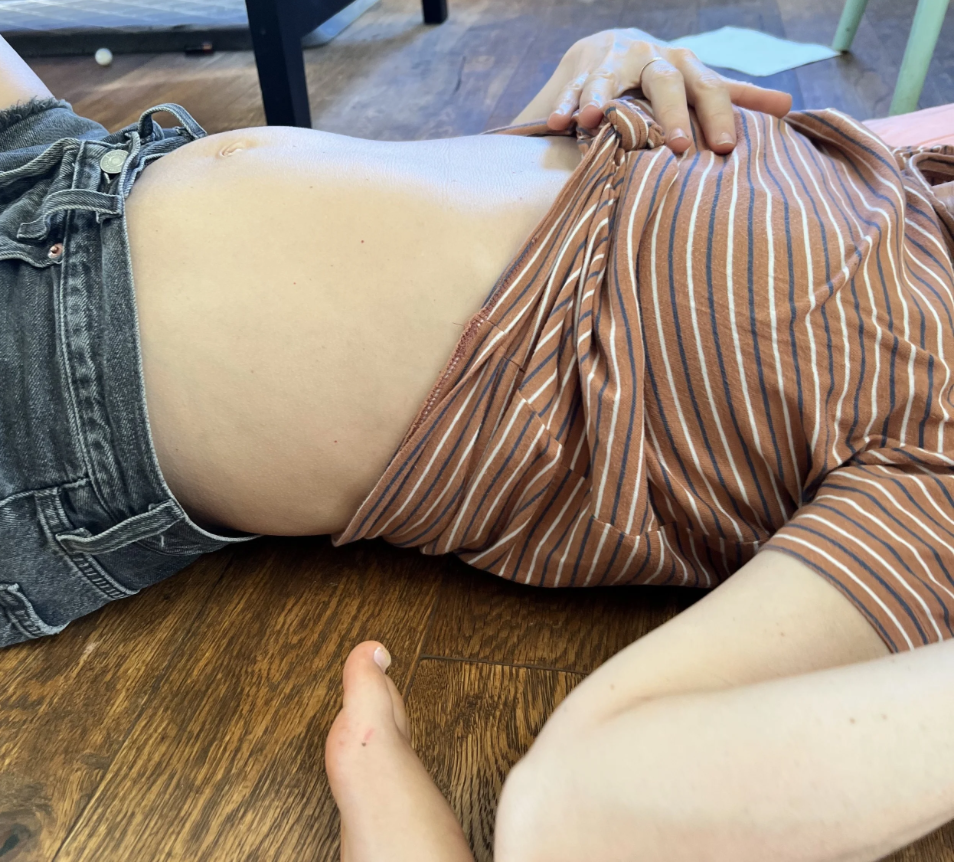
An example of what SIBO bloating can look like within 20 minutes of eating a meal (photo courtesy of my son; model being me ;)
The Small Intestine (The Shire) The small intestine, however, is meant to be a quiet, closer to sterile place dedicated to one thing: nutrient absorption. While the colon holds 10^12 bacteria (that’s a quadrillion!), your small intestine should only have about 10^3… one thousand. See the difference? It’s like the large intestine in a sold-out Taylor Swift arena, and your small intestine is a small game of charades in the Shire.
In SIBO, however, the bacteria from the colon (or overgrown locals) move into the small intestine. Imagine that stadium’s worth of rowdy party-goers trying to cram into Frodo’s living room.
Not only do they cram in, but they also…fart. Yes, when you eat, these bacteria eat too. Then they process your food and ferment it (outgas it) right in the 17-foot stretch of your small intestine. This produces gases (hydrogen, methane, or hydrogen sulfide) that have nowhere to go. Because the small intestine isn't designed to expand like the colon, it distends. This is one of the realities of Endo Belly and abdominal bloating.
Now that you have a general overview of how SIBO and endo belly are connected, let’s break down the three different types of SIBO and how each one can impact your symptoms.
Hydrogen SIBO: "Quick, to the toilet" kind of digestive symptoms
Hydrogen SIBO just means the bacteria that usually belong in your colon have staged a takeover of your small intestine. When these bacteria encounter undigested carbohydrates (especially high-FODMAP ones), they ferment them prematurely (before the large intestine), releasing a surge of hydrogen gas as a byproduct.
This "early fermentation" in the wrong place (i.e. the party is now in the Shire) is the primary culprit behind endometriosis belly symptoms like freak bloating and diarrhea; the gas creates internal pressure and irritation that typically manifests as IBS-D symptoms or that uncomfortable, "bloated belly" feeling almost immediately after you eat.
The silver lining is that Hydrogen-based SIBO is often the most straightforward to address, especially compared to its more stubborn methane- or hydrogen sulfide-based cousins.
Methane SIBO/IMO: The "Bloated Belly" Squatters (hello constipation!)
We now know that some of us aren't dealing with bacteria at all, and that it isn't limited to the small intestine. So the next type of “SIBO” isn’t really SIBO (technically at all): it’s “Intestinal Methanogen Overgrowth” or IMO. IMO is when we have an overgrowth of Archaea, and it can be in the small and/or large intestine.
Archaea are some of the oldest life forms on Earth. They aren't bacteria; they are a completely different "domain" of life. When these specific microbes (mainly one called Methanobrevibacter smithii) overgrow anywhere in your digestive tract, it can cause an extreme slowdown and an extremely heavy, brick-like feeling of bloating.
If SIBO is a loud, chaotic Taylor Swift concert in your living room (omg, imagine!), IMO is a group of slow-moving, heavy-breathing squatters who "parked the car" in your driveway, blocking the party-goers in. That's because they also eat the Party-ers leftovers! Let me explain:
The Methane "Handbrake": While SIBO bacteria produce hydrogen gas (which often causes fast transit or diarrhea), Archaea consume that hydrogen and exhale methane. This is good in a way (because they eat an extensive amount of hydrogen that would really expand you big-time), but also bad because methane itself is a challenging gas to be stuffed with. Methane is a much denser, more "expansive" gas than hydrogen. It physically slows down the transit of your gut (peristalsis). So, while you might be eating "clean" or "light," the methane is:
Paralyzing the gut wall, so food sits there longer.
Expanding, which creates that rock-hard, painful "Endo Belly" distension and severe abdominal bloating.
This is why IMO is the primary driver behind the "stubborn" constipation and the acid reflux (GERD) so many endo warriors face. The traffic is backed up for miles, and nothing can move forward.
IMO also loves endometriosis because Archaea are "scavengers." They thrive in stagnant environments and also on hydrogen. Because the endometriosis body is often swamped with pelvic and abdominal inflammation (and sometimes structural scar tissue and adhesions), which slows transit time, it creates the perfect, slow-moving environment that Archaea adore.
In that 2025 study, we see 63.2% of endo patients had IMO… nearly two-thirds! This explains why so many of us struggle with that 'concrete' feeling in our gut—methane is notorious for slowing digestion to a crawl and even driving that burning acid reflux we often mistake for other gastrointestinal symptoms.
Note: If you have IMO, you probably also have hydrogen SIBO. Since Archaea feast on hydrogen, if you have a lot of methane, you can assume you probably also have SIBO to a certain extent.
Hydrogen Sulfide SIBO: Rotten Eggs + Abdominal Bloating for the Win
Hydrogen Sulfide SIBO is less common, and also doesn’t play by the same rules as the others.
While the other types thrive on carbs, H2S SIBO means the bacteria (like Desulfovibrio) are actually feasting on sulfur-containing compounds found in high-protein foods like red meat and eggs, as well as healthy staples like garlic and kale. The result isn't just standard abdominal bloating; the hallmark is often gas that has a distinct "rotten egg" smell.
Addressing this version is significantly more complex because it often hides in plain sight. Traditional breath tests only measure hydrogen and methane, meaning many people with H2S SIBO are told their results are "normal" even when they feel profoundly unwell with severe stomach pain. Treatment is a steeper climb as well; these bacteria are notoriously resilient and often require a specialized protocol that includes bismuth (to "mop up" the gas) alongside specific antimicrobials.
Furthermore, the standard Low FODMAP diet—which is the "gold standard" for hydrogen SIBO and IMO—can actually make symptoms worse for this type of SIBO if it leans too heavily on high-sulfur proteins. For an endo patient, identifying this specific subtype is crucial, as the intense chronic inflammation it creates can be the invisible "fuel" keeping pelvic pain and "endo belly" on high alert.
Now that we've explored the different types of SIBO, let's look at how these conditions are tested and diagnosed.
Overlapping Symptoms of SIBO and Endo: From Loud to Silent
As you can see, different types of SIBO produce different GI symptoms. Sometimes they're loud, although sometimes they’re silent. Indeed, "silent SIBO" is a thing, and specifically a thing I dealt with; it’s why I didn’t realize I had SIBO for so long, and why I’m certain many women out of the 92% who tested positive were surprised too.
But SIBO isn't always about what's happening in the toilet; it’s about the systemic fallout of having a bacterial "party" in the wrong part of your digestive tract. When the small intestine—which is supposed to be your nutrient absorption hub—is compromised, the symptoms can show up in ways that seem totally unrelated to digestion.
So, for those of you without heavy-hitting SIBO symptoms (like severe diarrhea, constipation, or rotten egg gas and bloating), here are some other clues:
The "Silent" SIBO Checklist:
Nutrient Deficiencies (The "Malabsorption" Clue): Even if you’re eating a perfect, anti-inflammatory diet, SIBO bacteria can "steal" your nutrients before you get a chance to absorb them. If you have chronic low B12, zinc, iron, or Vitamin D that won't budge despite supplementation, SIBO might be the thief in the night.
Brain Fog and Fatigue: When bacteria ferment food in the small intestine, they produce metabolic byproducts (like D-lactic acid) that can cross into the bloodstream. This can leave you feeling "drunk," spaced out, or utterly exhausted just an hour after eating.
Histamine Intolerance & Skin Issues: As we discussed, SIBO damages the gut lining, where we produce the enzymes to break down histamine. If you find yourself suddenly reacting to everything—getting itchy, red, or congested after a glass of wine or some leftovers—your gut "bucket" might be full.
Headaches, congestion, eczema, rashes, and other strange inflammatory side effects: SIBO causes chronic inflammation, so if you have silent SIBO, you may start to realize it’s only silent about digestion, yet you have a host of other issues.
GERD: IMO is especially good at causing acid reflux (GERD) due to the increased pressure. Sometimes we think we just have a lifelong GERD issue that simply doesn’t go away, when we actually have IMO.
Weight Fluctuations: For some, SIBO (especially the hydrogen-type) can cause unexplained weight loss. For others, the chronic inflammation and hormonal and metabolic changes caused by methane (IMO) can make it feel impossible to lose weight, no matter how much you exercise.
Restless Leg Syndrome (RLS): It may sound wild, but research has linked SIBO to RLS. The systemic inflammation and potential nutrient depletion can irritate the nervous system, leading to those "jumpy" legs at night.
Why "Silent" Doesn't Mean "Safe"
Even if your SIBO is silent, it is still fueling the fire. Every time those bacteria ferment, they release endotoxins (LPS)that cross into your pelvic cavity and stimulate endometriosis lesions and symptoms. Whether your symptoms are loud or quiet, the impact on your chronic inflammation levels is the same. This is why digestive symptoms are just one piece of the puzzle—we have to look at the "hidden" clues to get the full picture.
How to Test: Intestinal bacterial overgrowth (SIBO)
At this stage of my career, I can predict with near certainty that a client has SIBO without any test at all based on IBS symptoms alone. If you have endo plus chronic diarrhea or constipation and persistent bloating that improves with a lowFODMAP diet? Probably a shoo-in. Terrible, rotten egg-type farts that get better on a low-sulfur diet?
Still, testing is important because knowledge is power—especially when it comes to choosing the right treatment strategy for your own, unique digestive system. "Blasting" your gut with the wrong antimicrobials because you guessed the wrong type can actually set your progress back. Testing allows us to:
Identify Your Specific Gas Profile: You need to know if you're dealing with hydrogen, methane (IMO), or hydrogen sulfide. Each one requires a different "eviction" strategy. For example, what clears hydrogen won't always budge stubborn methane.
Establish a Baseline: If you have severe abdominal bloating, you want a hard number to look back on. This helps you track whether your anti-inflammatory protocol is actually working or if your digestive issues need a different approach.
Differentiate from Other Gastrointestinal Conditions: While the "91.9% study" is a bombshell, we still need to rule out other culprits such as large intestinal dysbiosis, fungal overgrowth (SIFO), or even the physical impact of endometriosis on the bowel wall.
Provide "Doctor Data": If you are considering excisional surgery, having a positive SIBO test in your hand is an invaluable piece of clinical evidence. It helps your surgical team understand that your abdominal pain is a multi-layered issue involving both the pelvic cavity and the digestive tract.
Clinical Breath Testing
Stool tests (like the GI Map) are excellent for analyzing the "Taylor Swift Concert" happening in your large intestine, but they are notoriously bad at finding SIBO. Why? Because they don’t tell you where the bacteria are living. To find the "upstairs" invaders in the small intestine, you need a breath test.
A clinical breath test can cost around $250 per go, and since it’s a "one-and-done" kit, you have to shell out another $250 every time you want to check your progress post-treatment. If you go the clinical route, the Trio-Smart is the current "Gold Standard" because it’s the only one that tests for all three varieties (Hydrogen, Methane, and Hydrogen Sulfide).
At-Home Testing with FoodMarble
However, if you want to avoid the "subscription model" of clinical testing, I have an at-home hack I love: The FoodMarble Aire 2. While lab tests are a snapshot in time, the FoodMarble is a movie. It’s a tiny, high-tech device that measures hydrogen and methane levels in your breath via a portable tester and a synced app. If you want to monitor your own "Shire" ecology and reduce bloating 24/7, it’s the ultimate "bang for your buck" for the endo patient who wants to track their fermentation levels daily, not just once a year.
DIY SIBO Challenge Steps
To test for SIBO with the FoodMarble, you need the device plus a "challenge substrate" (the food for the bugs). In a lab, they use lactulose or glucose. Since lactulose is prescription-only in the U.S. and glucose can lead to false negatives, I recommend testing with Inulin.
How to Informally Test:
The Prep: One week before, stop taking probiotics. The day before, follow a "boring" prep diet—think plain chicken, white rice, eggs, salt. No seasoning, no veggies, no sugar, no fun.
The Baseline: On the morning of the test, take a reading. If your hydrogen is in the "green" (low), you’re good to go.
The Challenge: Mix 10g of inulin powder (about 3 rounded teaspoons) into 8 oz of water and drink up.
The Discovery Phase: Set a timer and take a reading every 15 minutes for 2.5 to 3 hours. Yes, it’s a long time, but think of it as a journey of discovery as you follow that inulin through your tract. Grab a book (I recommend Heal Endo!).
Interpreting the "F-Bus" (Fermentation Score):
Hydrogen: If you see a score of 4 or more before the 90-minute mark, that’s a red flag. It means bacteria are "pouncing" on the inulin while it’s still in the small intestine.
Methane: Methane is different. We look for levels above 2 or 3 at any point during the test.
The Colon Drop: If your hydrogen spike happens after 120 minutes, don't panic! That’s just normal, healthy fermentation in your large intestine.p-[
With testing covered, let’s move on to what you can do to address SIBO and endo belly for lasting relief.
A Few Pillars TO heal (of Many): As in Don't Obsess over the kill!
The biggest mistake SIBO "novices" make is becoming obsessed with the "Kill Phase." But if we don't address the Root Cause (motility, acid, adhesions, inflammation, the vagus nerve, and more), SIBO will return in roughly 60% of cases within a few months. This is why we need to address the entire ecosystem that fosters SIBO, rather than obsessing solely over eradicating the specific microorganisms.
Here are a few factors that also need to be optimized:
1. Optimize Upstream Disinfectants
2. Restore the Migrating Motor Complex
You can use prokinetics (like ginger tea, artichoke extract, LND, or MotilPro) and Vagus Nerve stimulation (like deep belly breathing, gargling, and nervous system retraining) to "un-mute" this signal and sweep the debris out of the small intestine.
3. Strategic Low FODMAP Approach
By reducing fermentable oligosaccharides, we reduce the metabolic "fuel" that SIBO thrives on. Healing the gut lining ensures that bacterial toxins stay out of your bloodstream.
4. Address Mechanical Obstructions
Because endo can come replete with adhesions, sometimes the "kinks" in the hose are physical. This is where pelvic floor physical therapy or visceral manipulation becomes a non-negotiable part of the healing puzzle, as well as considering a properly done excisional surgery if your SIBO simply cannot clear.
5. Regulate the Nervous System and Reduce Stress
Nervous system dysfunction and chronic stress are well-documented phenomena for the endo patient. Here’s why your belly cares: Your "Rest and Digest" system (the Parasympathetic branch) is the only one that can digest and run your "internal dishwasher" (the MMC). When you are stuck in survival mode, your body literally turns off the power to your gut. You can’t "digest" your way out of a proverbial tiger attack, even if your body think tha checking emails is that tiger.
The result? Stagnant digestion, a broken "clearing wave," and an open invitation for SIBO and IMO to take over are huge reasons you may not be digesting well, have reduced motility, bloat within just a few hours, and have poor blood flow to the intestines. These factors can all contribute to that "terrain" I spoke of where SIBO can thrive. Addressing this issue is imperative to move past the SIBO ecosystem. I highly recommend programs like DNRS!
Once these factors are addressed, we can consider the “removal” phase! You can do this with anti-inflammatory herbs, antibiotics, or perhaps SIBO yogurt. Check out the book Super Gut for all the research behind this.
Now that you know the pillars of recovery, let’s zoom out and see how this fits into the bigger picture of your health.
The Big Picture
You aren't broken, and your bloating isn't "all in your head." By shifting from a "kill-only" mindset to a "body ecology" mindset, you can start to deflate the Endo Belly and take back your energy.
What’s Next? Treating SIBO is about more than just food; it’s about the nervous system signal. In my next post, we are going to dive deep into the Vagus Nerve and simple, non-food techniques that "un-mute" your gut's ability to heal and ease SIBO and endo belly bloating.
Research References
Halfon, M., Estrade, J. P., Pénaranda, G., et al. (2025). High prevalence of small intestinal bacterial overgrowth and intestinal methanogen overgrowth in endometriosis patients: A case–control study. International Journal of Gynecology & Obstetrics, 170(1), 284–291. https://doi.org/10.1002/ijgo.15963
Khan, K. N., et al. (2024). LPS and the progression of pelvic endometriosis: The gut-pelvis axis. Fertility and Sterility. (Explores how bacterial endotoxins act as "fertilizer" for lesion growth).
Smith, J. R., & Doe, A. (2024). Vagus Nerve "Muting" in Systemic Endometriosis: Cytokine-driven dysmotility. Journal of Neuro-Gastroenterology. (Discusses the inflammatory "bathing" of the vagus nerve).
Pimentel, M., et al. (2024 update). Methane as a local paralytic in intestinal transit: The IMO paradigm. American Journal of Physiology. (Research confirming methane's role in slowing peristalsis).
Rangon, C. M., & Staats, P. S. (2024). Is vagus nerve-mediated regulation of immunity an etiological target for therapeutic intervention in endometriosis? AccScience Publishing. https://doi.org/10.36922/mi.4389
Mathias, J. R., et al. (1998). Relation of endometriosis and neuromuscular disease of the gastrointestinal tract: New insights. Fertility and Sterility, 70(1), 81–88.
Moore, J. S., Gibson, P. R., et al. (2017). Endometriosis in patients with irritable bowel syndrome: Specific symptomatic and demographic profile, and response to the low FODMAP diet. The Australian & New Zealand Journal of Obstetrics & Gynaecology, 57(2), 201–205.
Leonardi, M., et al. (2020). Endometriosis and the microbiome: a systematic review. BJOG: An International Journal of Obstetrics and Gynaecology, 127(2), 239–249.
Dukowicz, A. C., Lacy, B. E., & Levine, G. M. (2007). Small intestinal bacterial overgrowth: a comprehensive review. Gastroenterology & Hepatology, 3(2), 112–122.
Pyleris, E., et al. (2012). The prevalence of overgrowth by aerobic bacteria in the small intestine by small bowel culture: relationship with irritable bowel syndrome. Digestive Diseases and Sciences, 57(5), 1321–1329.
Davis, W. (2022/2024 update).Super Gut: A Four-Week Plan to Reprogram Your Microbiome, Restore Health, and Lose Weight. (Hachette Books).