
Reclaiming Liminal Space in 2026: Chronic Illness and the In Between
As someone who loves to write, I recently stumbled upon a new word — liminal — and kind of fell in love. It’s just so darn descriptive about a “place” that really does need more language around it. It names something many of us have lived inside, often for years, without ever having a clear definition for where we are.
At its core, liminal describes a space of transition. The term comes from the Latin word limen, and it means threshold: think of a doorway you’re standing in, rather than the rooms on either side. You’re not fully inside, but you’re no longer outside either. But liminality doesn’t only describe physical thresholds. It also describes inner states — the psychological terrain of major life transitions — when you’re no longer who you were, but not yet who you’re becoming. It’s a liminal state of self and story, the in-between place where your mind keeps asking for certainty and life keeps offering… well, not that.
Think of a college graduate: no longer a student, an identity they’ve held their entire life, yet not quite an “adult” in the way they imagined. Or think of a woman with her first newborn — suddenly fully responsible for another human in ways she could never have predicted, yet so new to the role that she hardly feels like a seasoned “mum.” (Hi, yes, that was me circa 2018.) In both cases, you’re in the in between: not who you were, not who you will become, and also not entirely sure how long this crossing lasts.
And while the concept is simple, the lived experience is not.
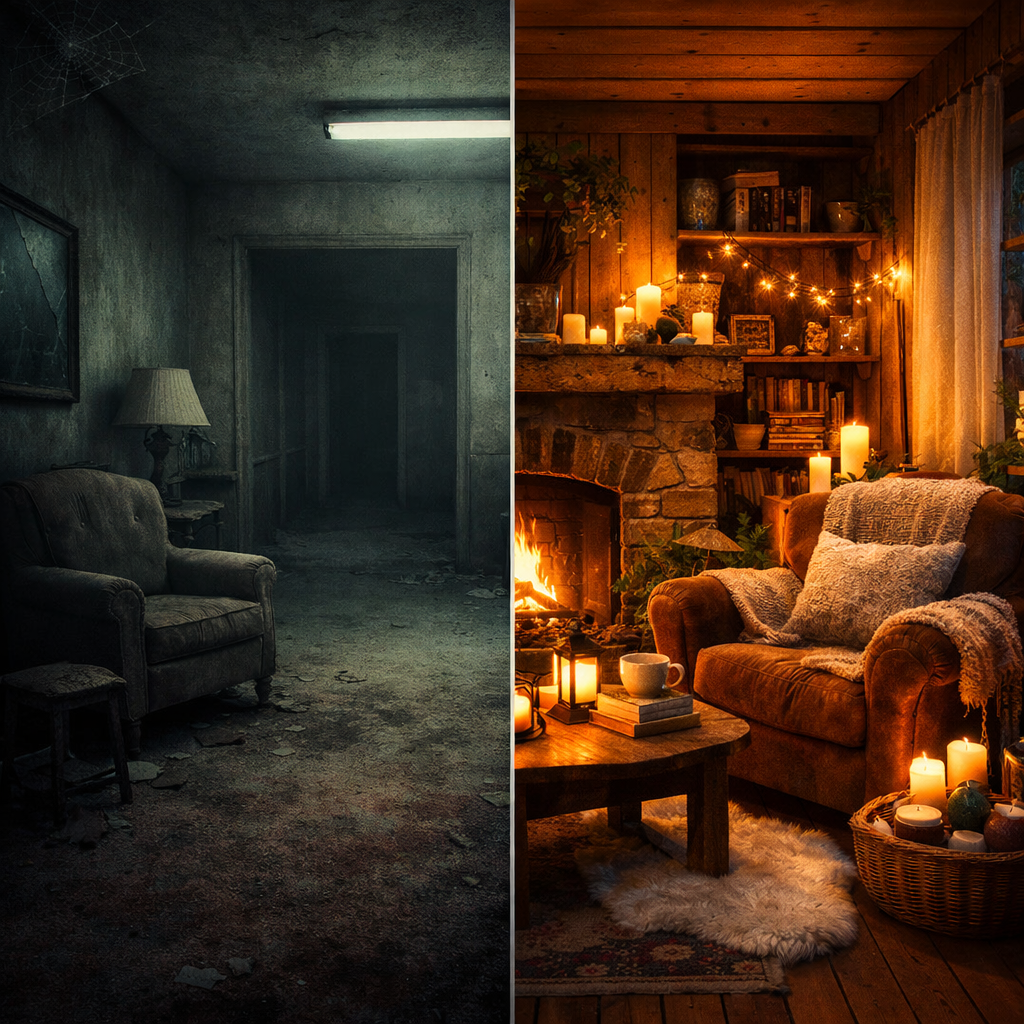
Let’s chat about the two ways to approach this year. Same circumstances, different perspectives.
These in-between spaces can be meaningful and hopeful in some cases, or dark and deeply uncomfortable in others. Think of the death of a best friend, or a terrible divorce. Liminal spaces feel like being unmoored: charged anxiety, grief, disorientation, or a sense of losing solid ground beneath your feet. Transition periods come in many forms, and some are far more destabilizing than others — that’s for sure. Sometimes you can still function. Sometimes you’re walking around doing life while feeling like your floorboards are missing.
But in mulling over the meaning of liminal spaces — and where we culturally grant them weight (the death of a loved one, a terrible divorce), or perhaps little value (the summer after high school, for example) — there is a big one we rarely talk about, and desperately need to:
The liminal space that accompanies chronic illness and long-term healing.
I remember being in my own liminal space after my endometriosis diagnosis, through my early infertility journey, thinking both, “this sucks” and “get me out of here!” It wasn’t until I started to gain real traction in my healing that my mindset shifted at all. But now, looking back, I can see just how much energy I wasted — seriously wasted — overthinking, resisting, and honestly hating the liminal space I was dwelling in. And what’s wild is that the liminal space didn’t care how much I hated it. The liminal space just… remained.
And you might be thinking, “Duh, Katie. Who would like it?”
Exactly.
That’s precisely why I’m writing this article — not to force anyone to like a liminal space charged with symptoms, unending fatigue, pain, or loss of identity. No no no. I’m here to support a shift in perspective so that we don’t spiral, waste precious energy, or become bitter, angry monsters (which I nearly did). It's about how learning to live well inside a place of uncertainty actually becomes its own form of medicine.
So if you feel like your head is currently where your feet are supposed to be — and vice versa — and you don’t know how long you can endure this emotional place of “oh my god,” this article is for you.
Why Liminal Spaces Feel So… Uncomfortable
Even without chronic illness, liminal space feels unsettling for a very simple reason: the human nervous system does not like unresolved transitions. No, we do not stop halfway down the subway stairs and calmly stand at that threshold, totally at ease. Never. We are wired to orient ourselves in a time based framework (i.e. past, present, future) and to anticipate what comes next. When we don’t know what’s coming, we don’t like it. Plain and simple.
This is especially true in psychological liminal states, with chronic illness being a perfect example. The stretch of time between a biopsy and the results. The first year after an endometriosis diagnosis, when treatment has begun but life is far from “normal”. The months of watchful waiting after a successful surgery, when the “freak out” has passed but wellness hasn’t arrived. These are suspended moments — like the slow-motion car crash in a thrilling movie — where time seems stretched and kind of scary — precisely what the nervous system finds so difficult.
Even… creepy.
The Creepy Liminal Space Aesthetic and Why the Internet Gets It
In fact, contemporary internet culture has popularized images of liminal space as distinctly eerie, almost like a shared nervous-system language: abandoned malls, empty school hallways, yellow carpets under fluorescent lights, the Backrooms meme that went viral around 2019, and entire corners of an internet aesthetic devoted to this “whole vibe.”
There’s even r liminalspace, where people trade liminal imagery the way others trade travel photos, because these photos evoke something primal: the same feeling of being suspended in creep-zone!
What’s so striking is that many of these physical liminal spaces are not inherently threatening. Yet, they feel wrong because they’re places designed for passing through (perhaps very quickly), not for being lived inside. That’s why hotel hallways, waiting rooms, empty stairwells, and quiet lobbies are so often considered liminal; they are transitional places, transitional areas, built for movement, built for one moment, built for arriving and leaving, not for setting up shop.

Liminal spaces, be they physical or psychological, feel uncomfortable because we want to quickly move through them. However, they can also be a chance for transformation if we turn off the panic…
If you're wondering why I'm talking about creepy hallways on an endo blog, don’t abandon ship yet! Here's why: Understanding this feeling of unease in physical liminal spaces helps us understand our discomfort in the psychological ones. We really, really don't like inhabiting a "hallway" of life that feels so sticky. So when psychological liminal states (like chronic illness, for example) stretch far longer than expected, that same unease surfaces in the body, as if we were stuck in that fluorescent hallway with no exit sign...Eww. It can feel like endless background noise in the nervous system — a constant hum of “what now?” that never quite turns off. It can create a heightened sense of vigilance, even when you’re lying on your couch doing nothing, literally.
Please note, this is not anyone's fault! Biology plays a large role here. Human brains are wired to prefer predictability and clear categories. Research in cognitive psychology has long described something called intolerance of uncertainty— the degree to which ambiguous situations feel distressing to us. I felt this acutely when I lived in Senegal, where very little was ever 100% certain. Even something as simple as whether the bus would come, or a doctor would be open, could feel destabilizing. Over time, that constant not-knowing had a way of unraveling me and making me feel hypervigilant.
Alongside biology, culture also plays a powerful role in why liminal space feels so unsettling. Western societies are deeply invested in clean narratives of progress and resolution. We like timelines. We like schedules. We like knowing what comes next. Even our idea of healing follows a script: diagnosis, treatment, improvement, return to normal life. When that arc stretches into months or years — or never quite resolves — it creates a sort of social friction. We don't get it, nor do our friends and family, who kind of have no idea how to support a sickness without a normal healing arc.
And that friction matters for mental health. Because when your internal reality doesn’t match the cultural story, you start to feel like you’re doing life wrong. You start to wonder if you’re the problem. You start to shrink yourself to fit a designed context that was never built for prolonged ambiguity, and this can be detrimental to the human spirit (yes, including yours).
Chronic Illness as a Liminal State and a Transitional Period
Shifting our perspective about liminal space (which we'll talk about soon!) becomes even more important when we realize that we may be here — in this liminal space — just a teeny bit longer than expected. How long? Who knows! That’s the humorous gift of liminal spaces: we just. don’t. know. It’s the ultimate wiggle room and the ultimate torment at the same time.
I was in my healing-from-endometriosis-liminal-space for about eight years, if I had to estimate. Some women are here far longer. Others far less. But the defining feature is not the timeline — it’s the feeling of suspension while we are here.
Chronic illness suspends people between the “old” healthy self and an unknown “future” self. It also traps people between clear social categories: sick enough to need accommodations, but not sick enough to be believed; well enough to look fine in photos, but never actually “off duty” from managing their body. Living between fully ill and fully well is sticky. It’s an in-between zone where you keep trying to act normal while your body keeps refusing the script.
Sometimes we remain in this suspended state far longer than we ever imagined! And that prolonged lack of resolution — shaped by both biology and culture — is what makes liminality feel so deeply unsettling, not just for us, but for the people around us as well. It’s not just “I’m sick.” It’s “I’m in a transitional period with no clear end date.” That is a very different psychological load.
Why Liminal Spaces “panic” can Detrimentally Affect Us
For most people, some uncertainty is manageable. But chronic illness introduces uncertainty at every level: diagnosis, prognosis, daily energy, treatment effectiveness, and the future itself. When you can’t predict how you’ll feel tomorrow — or next year — the nervous system stays in prolonged vigilance. The stress response remains partially activated, not because there’s immediate danger, but because nothing ever fully resolves.
This creates a low-level wash of “something’s wrong” that colors everything. Let’s call this panic-level uncertainty, because if we’re being honest, at this point, you’re probably panicking. I know I was.
Over time, this kind of sustained panic-level uncertainty — like an uncertainty ultra-marathon — contributes to burnout, anxiety, depressive symptoms, and nervous system dysregulation. We feel rattled by the unknown, disoriented about direction, and, as biological creatures who like to know where to place our feet next, it can start to feel as though the ground beneath us is made of glass. It can also start to distort your own thoughts, because a nervous system in panic mode doesn’t always think things through clearly.
On top of that, there is an absurd amount of panic-inducing information online about endometriosis. Some of it is true (like, yes, endometriosis can progress), some of it is not (in fact, endometriosis is more likely to regress or stabilize than progress). Or, the lovely ‘branded’ phrase for endo I see repeated often: “there is no cure.” Of course, there are many issues with no cure, from acne and eczema to autoimmune or cancer, yet endo is the ONLY one with this tagline. Welcome to the endometriosis panic club, everyone (insert my enormous eye roll because I believe this type of information bullying is unfair and unproductive).
Here’s the Catch-22: constant worrying about this space of uncertainty can, in itself, trigger nervous system dysregulation, further destabilizing the body. Think of it as a chronic stress response caused by something intangible — the unknown — now actively contributing to your disease state. Because yes, we know that high levels of stress are associated with increased pain, insomnia, hormonal imbalances, microbiome disruption, chronic fatigue, and even greater susceptibility to infections and viruses.
So ask yourself, are you stuck thinking, “I can’t calm down until this is over!”? If so, this is an example of a nervous system responding exactly as it should when it feels trapped.
But this is also where a gentle — and veryyyyyy important — reframe becomes necessary. We need to become brain-Jedi here, retraining our reaction to this space, our perception of being in it, and learn — imperfectly — how to find peace inside it. Not because we’re giving up! Not because we’re resigning ourselves to suffering! Not at all, but because staying in panic mode actively makes things worse.
This peace might even help you exit the liminal space faster than expected. It creates more internal room for clarity and steadiness. And steadiness is not just emotional; it’s physiological (meaning it can help support the healing process).
Ok, ready to move into the positive? Let's go!
Reclaiming Liminal Space: Panic vs Presence in an In-Between Space
Liminal spaces can deplete you. They can drain your energy and trigger panic. The prefrontal cortex goes offline, fear takes over, and the internal chant becomes frantic: “I don’t want to be here! I am trapped!” That, my friends, is the mantra of panic. That’s the same feeling you get when you step into a weird, empty building at night and suddenly your body is scanning for danger even though nothing is happening.
And here’s the key distinction we’re building toward: staying in liminal space in panic versus in regulation leads to very different lived experiences. This is true whether the liminal space is illness, grief, postpartum, divorce, or any other prolonged in between. The external situation may not change immediately, but your relationship to it can.
This does not mean doing nothing. It doesn’t mean saying, “Ah yes, I will stay calm and be okay with being here forever.” It’s more akin to preparing for a long winter when you love summer. Or rehearsing for a play when you hate public performances. Or renovating your house and choosing, consciously, to live inside construction as gracefully as possible — knowing that when the house is finished, life will be better.
The difference is not the circumstance, but rather how the nervous system is supported while you’re inside it. Yes, you can and should be working with doctors, pelvic floor therapists, integrative care folks, reading best-selling healing books like mine (Heal Endo), and doing anything else that helps you move forward.
If this is the story arc you never asked for—and one that many of us with chronic illness will inhabit far longer than expected—then it becomes necessary to rewrite how we live inside it. The goal isn’t to escape the in-between as quickly as possible. It’s to make it livable. Maybe even—dare I say—enjoyable in pockets?
Which is why it matters, deeply matters, that we kick out the creepy, nervous-system-dysregulating version of liminality and consciously invite something warmer in its place. So, enough about eerie hallways and fluorescent dread. What if we reclaimed liminal space as something… homier? If we’re going to be here a while, we might as well pour some tea and roll out the sheepskin rugs.
Here are three ideas for New Years resolutions this year
1) Hygge: Making Liminal Space Cozy
This is where I love the concept of hygge—another word as satisfying and descriptive as liminal, but with a completely different nervous-system signature. Like, polar opposites.
Hygge (it's pronounced hoo-guh, I won't tell you how I was pronouncing it ;) comes from Scandinavia and describes a felt sense of nourishment, coziness, and contentment, often cultivated during long, dark winters. And to be clear: those winters are inhospitable! I mean, yeah, maybe reindeer and Santa live there, but most bodies were never meant to thrive there without adaptation.

Hygge is the opposite of creepy transition! It’s cozy transition. Pretty cool, huh?
And adaptation is the keyword. Hygge didn’t come about because Scandinavians loved 20 hours of darkness a day and polar blizzards. It arose because they couldn’t escape it, yet they wanted to live nice lives. So when the external environment is harsh, unyielding, and longggggg, the only sane option is to soften the internal environment. Borrowed into the context of chronic illness, hygge becomes even more powerful. It’s a reminder that even while waiting—even while uncertain, symptomatic, or suspended between identities—the nervous system still deserves cues of safety.
Practically speaking, this matters a lot. If you’re not going out as much because of symptoms, your home becomes more than a place you happen to be. It becomes your primary ecosystem. Your castle. Your most important physical space of all. Making it feel inviting is ... protective. A nice blanket, lots of natural light, and indoor plants that bring joy.
More than that, hygge invites us to rethink how we fill our time as the seasons change and the things we once loved doing are now out of reach. I know many people with chronic illness come from lives built on intensity (me included)—marathons, deadlines, travel, achievement. When illness removes or limits those outlets, the loss can feel existential ... perhaps crisis-level.
Hygge suggests pivoting with grace rather than in crisis. If you find yourself horizontal more often than sprinting mountains or standing in boardrooms, ask what this season is asking for instead. Let me give you some amazing, less-intense-but-super-cool ideas: Music, drawing, watercolor, ceramics, learning to sing on key, knitting, writing (my fav), cooking something exquisite and slow. These here are activities designed for nervous systems that need steadiness rather than adrenaline (read my article on Pottering here).
2) Becoming an Uncertainty Master in a Liminal State (with Help from Buddha and Socrates)
I’m currently reading a book called Buddha, Socrates, and Us: Ethical Living in Uncertain Times (I highly recommend it), and I was struck by two things: first, that these two thinkers lived at the exact same time in history; and second, that both grounded their philosophies, quite literally, in uncertainty.
Both lived in periods of enormous instability: Political upheaval, social change, widespread suffering, no guarantee of safety, no neat story arcs promising that everything would work out if you followed the rules. Living then makes today look like a planetary luxury liner! Their lives were lived in a constant liminal space, one that was full of greusomeness.
Yet, instead of responding with obsession with control or false certainty or dogma, both turned toward gentle and peaceful inquiry. How do we live well when we don’t know?
Buddhism rests on the understanding that impermanence is not a flaw in reality—it is reality. Suffering only arises in liminal spaces, not because of the uncertainty, but because we demand that it be certain. Basically, if we stopped demanding, certainly we'd be a heck of a lot happier. Socrates echoed this in his own way, famously grounding wisdom in the admission of not knowing.
What strikes me, reading these traditions through the lens of chronic illness, is that neither treated uncertainty as something to resolve before life could begin. Uncertainty was the terrain. There is something profoundly comforting in that. If life was never meant to resolve cleanly—if it was always transitional, unfinished—then chronic illness is not an aberration from the human experience, but an especially clear invitation into it.
Not an easy invitation. But an honest one worth journaling about.
3) Leaning Into the Transformative Possibilities Inside Emotional Liminal Spaces
Liminal spaces are not inherently positive. It would be unhelpful—and honestly, cruel—to suggest that chronic illness is secretly a gift, or that suffering always leads to growth. No one would ever say it was a “gift” to lose a close friend simply because you learned something about grief!
And still—without forcing meaning onto pain—it is also true that some people, over months and years spent in this threshold territory, begin to notice that certain positive shifts happen anyway.
This is what I meant when I wrote in Heal Endo (on page 300), about “looking for silver linings.” For me, it was finding a deeper sense of joy in living and forging health in ways I never knew existed—after a childhood marked by autoimmune symptoms and long stretches of illness. For others, it’s discovering a love for teaching or advocating for health. Or realizing, painfully, that a career or relationship was a castle built on glass—and that while its collapse was devastating at the time, it also made room for something truer.

Priorities tend to shift as well. Relationships that drain you may start to be put aside, while creative work that feeds your spirit may take precedence. Community involvement might move from intensive volunteering to quieter, more sustainable forms of connection. In some ways, this resembles emotional minimalism—you give up a lot, and later discover how much of it had been weighing you down. Over years of fluctuation, a quieter form of self-discovery can take root.
Again, this isn’t settling. It’s recalibrating (another great word for helping us navigate liminal spaces), learning what actually matters over the long term, and it often becomes a form of incredible personal growth... albeit one that no one would have chosen voluntarily. If you’ve heard of a cracked ceramic bowl repaired with subtle kintsugi (gold seams) we can imagine the same in our bodies, and how brokenness, resilience, and genuine newness can coexist (perhaps even with beauty and awe).
Just FYI, these transformations are not moral obligations! Healing is not measured by epiphanies, spirit quests, or viral reels documenting your experiences. Some people move through chronic liminality without dramatic transformation, and that is equally valid. The point is simply this: the in-between space, for all its difficulty, is not always and only barren. Sometimes it holds something that feels like genuine newness, even excitement (yay!), even if you can’t see it clearly yet.
Key Takeaways Liminal Spaces in 2026: Reclaiming the Language of Liminality for endometriosis and beyond
Liminal space is not just an internet aesthetic of eerie hallways. It is a lived territory for many of us navigating chronic illness, recovery, and identity change! It is both physical and emotional, psychological and practical at the same time. It can show up as a hospital corridor or waiting room, an empty parking lot outside an imaging center, or the startling moment you realize you’re living in a different context than you expected.
The cool thing is that naming this space can reduce shame and isolation. When you have language for what you’re experiencing—when you know it’s considered liminal in the formal sense, recognized by anthropologists and psychologists alike—you’re no longer alone! You’re standing in a territory that others have mapped, even if each person’s journey through it is unique. No, this doesn’t solve the difficulties, but it offers a shared vocabulary for patients, families, and even doctors trying to understand one another.
The other cool thing is this: you won’t be here forever. I firmly believe that. With the right approach, people, techniques, and direction, you will eventually make it out of your liminal space. It may not be the exact direction you thought it would be … but finding a new normal, one that is enjoyable and full of love and warmth and wellness, is your human right. And I believe in you that you will get here. At least eventually :)
For now, over the coming months, I recommend that you try noticing and naming your own liminal moments. Waiting for results. Adjusting to new medications or dietary strategies. Learning new ways of cooking or eating or moving. Discovering a new baseline of energy in 2026. Pay attention to how liminal spaces feel when you’re in them. Treat this in-between not as a personal failure to “move on,” but as a landscape to be navigated—with friends, compassion, hygge, tools, and language! Let it be an in-between space you learn to inhabit with steadiness, rather than an in-between space that eats you alive.
You are no longer who you were. You are not yet who you’re becoming. And the space between—that threshold you’re standing on—deserves to be spoken about openly, with the honesty and dignity it requires.

What would happen if you inhabited your liminal space with peace? Where would you land?