Living in Endometriosis Remission: The Hierophany of an Ordinary Tuesday
An essay what living in remission actually looks like (psst: it doesn’t involve supplement protocols)
There is a time every spring, after the rainy winter months, that I always look forward to.
When we start eating dinner on the lanai again. (Lanai means porch in Hawaii)
In the past few weeks, the atmosphere shifted—the light staying out longer, and the warmth ebbing up a notch—and one night we just carried our plates outside and didn't go back in. We've been out there ever since.
Our property edges four hundred acres of forest on the north shore of Kauaʻi. By the time dinner is on the table, the sun is low enough behind the trees that their shadows begin to move across the lawn in these long, slow, glowing sweeps. It is one of my favorite things to watch—the closing of the day in the forest—and even though I have lived here long enough, it still amazes me. I have this deep appreciation for our tiny little nook on earth.
After dinner, now that the light holds, we are starting to resume our after-dinner adventuring. We go down to the monarch butterfly tree, or play on the lawn. Soon we will have enough time to go to a lazy little stream that runs through the forest. The kids run, walk, or fly at the speed of light on the One Wheel (just to challenge my nervous system strength). And I am reminded over and over: this. This is it. This is the whole thing. Why did I think it was something so different, for so long?
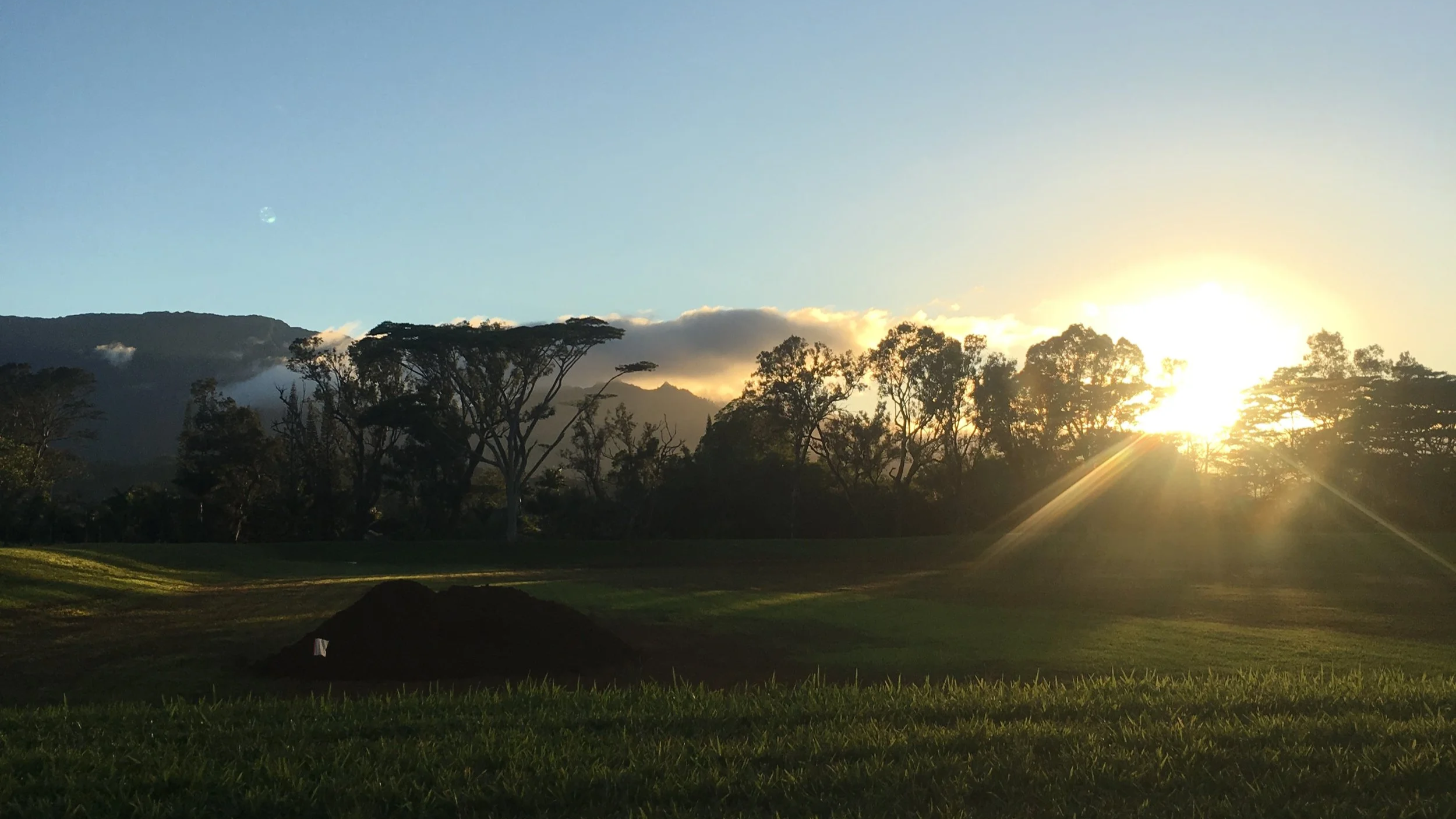
sunset over the forest
This, of course, is not an image of my whole day (which is full to the brim with responsibilities, like most people), just a snip at the end. But you might be surprised to hear I try to run my days as smoothly as my evenings; low in cortisol, high in ease. This is the pace, I’ve learned, a healthy life requires.
In Hawaii, we have a word for this pace of life. It's simple; we call it cruising. "What are you doing?" (Response, no matter what person is doing) “Just cruising." It is the art of being a happy camper with where you are and what you’re doing. In another blog, I use the word pottering to describe something similar: getting all our to-dos done without the urgency or stress we think we need to hold alongside. It took me a very long time to learn how to do it, but today I would argue that learning it is the reason I have been well for so long.
I have now been in remission from endometriosis for over ten years. Last year, advanced imaging confirmed zero visible endometriosis, and I have lived those ten years free of painkillers and oral contraceptives. This isn’t to say everything is perfect; there is no such thing. But the overarching theme of what has kept me stable was learning, slowly and very haphazardly, how to live in a way that doesn't cost me everything…including my health.
I’ve tried to explain this before, and it can be hard to understand at first glance. People want more specifics: which supplements, which diet, which intervention. And I understand why; I ask those questions too! I research them, I write about them (I mean, I wrote a whole book), and I will keep doing so because science matters and there is always more to learn.
But sitting on my lanai watching forest shadows cross the lawn, I know with absolute certainty that this is also medicine. It's actually starting to dawn on me that it might be more potent than anything else. The unhurried dinner, laughing about the insane feral kitten we adopted (why did we adopt one?), the unplanned after-dinner adventure that the responsible version of me would have said no to on a school night. These are the things that, when kept foundational, keep me well. While here, my dietary perfection can relax, my health "needs" slide, and I never stay up late researching the latest twinge or health issue that pops up.
This is what living in endometriosis remission looks like for me, which might be different from what some would expect. If I had pictured a life that kept me in remission in my early years of endo, I would have fantasized of no work, cold plunges at dawn, a private chef, and meditating for an hour before the children wake. The truth is, this is far from the life I live, and the foundation is far less photogenic: I spill the milk, and my stress hormones don't spike. I respond to life rather than react to it. The psycho part of the brain—the maniac part that used to take control of the reins—doesn’t get airtime.
And in the place where cortisol used to dominate, where the rushing and the negative spirals and the low-grade hum of threat used to crowd everything out, ease moved in. When that happens, it turns out sickness can become wellness, and ordinary things begin to feel extraordinary. That's the part I want to tell you about because this is what remission means to me, and it doesn’t need to cost a fortune in supplement protocols.
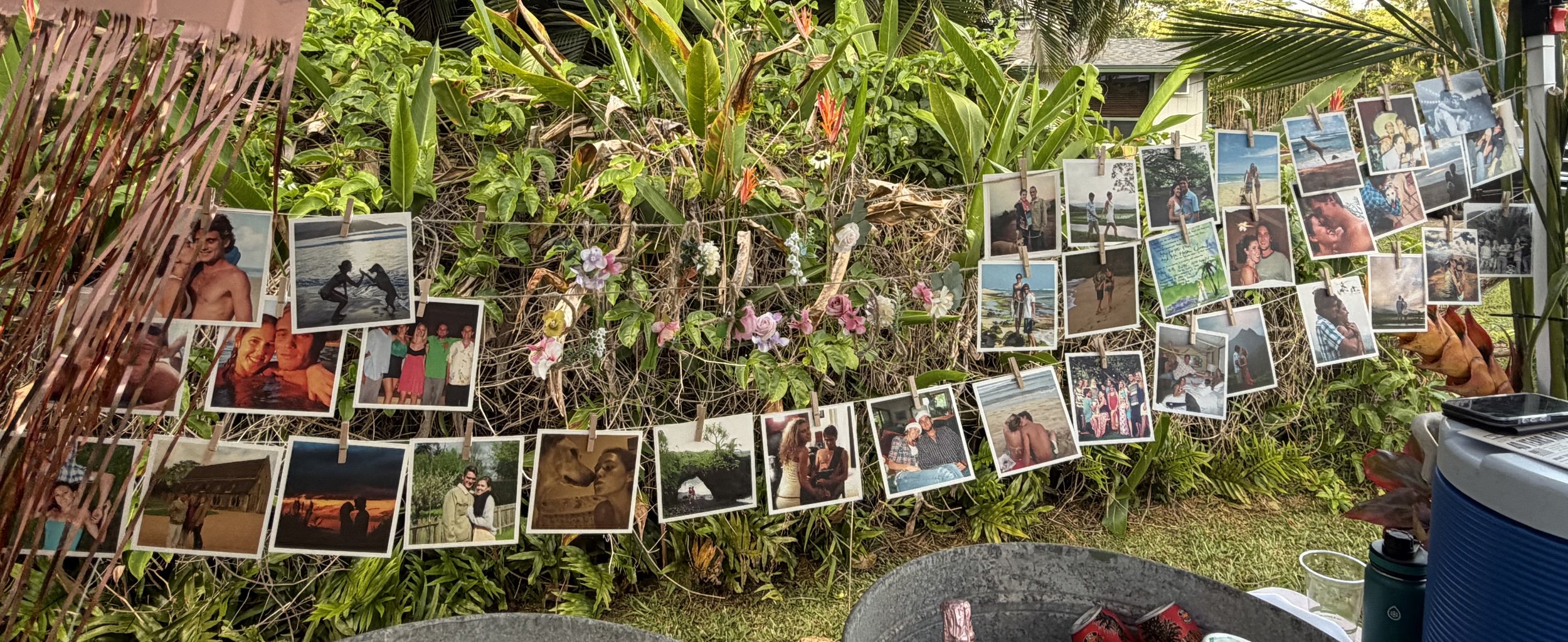
My husband and I threw a party last week to celebrate ten years married, twenty years together, and forty years old. We called it our 10-20-40. We wanted to renew our vows too (a lot changes in ten years!), so I took my notebook out to the lanai one morning and sat there for a long time before I wrote anything. Then I just started tearing up—with sentiment, yes, but also with recognition. I had recently learned a word that summed up exactly what I was feeling: hierophany.
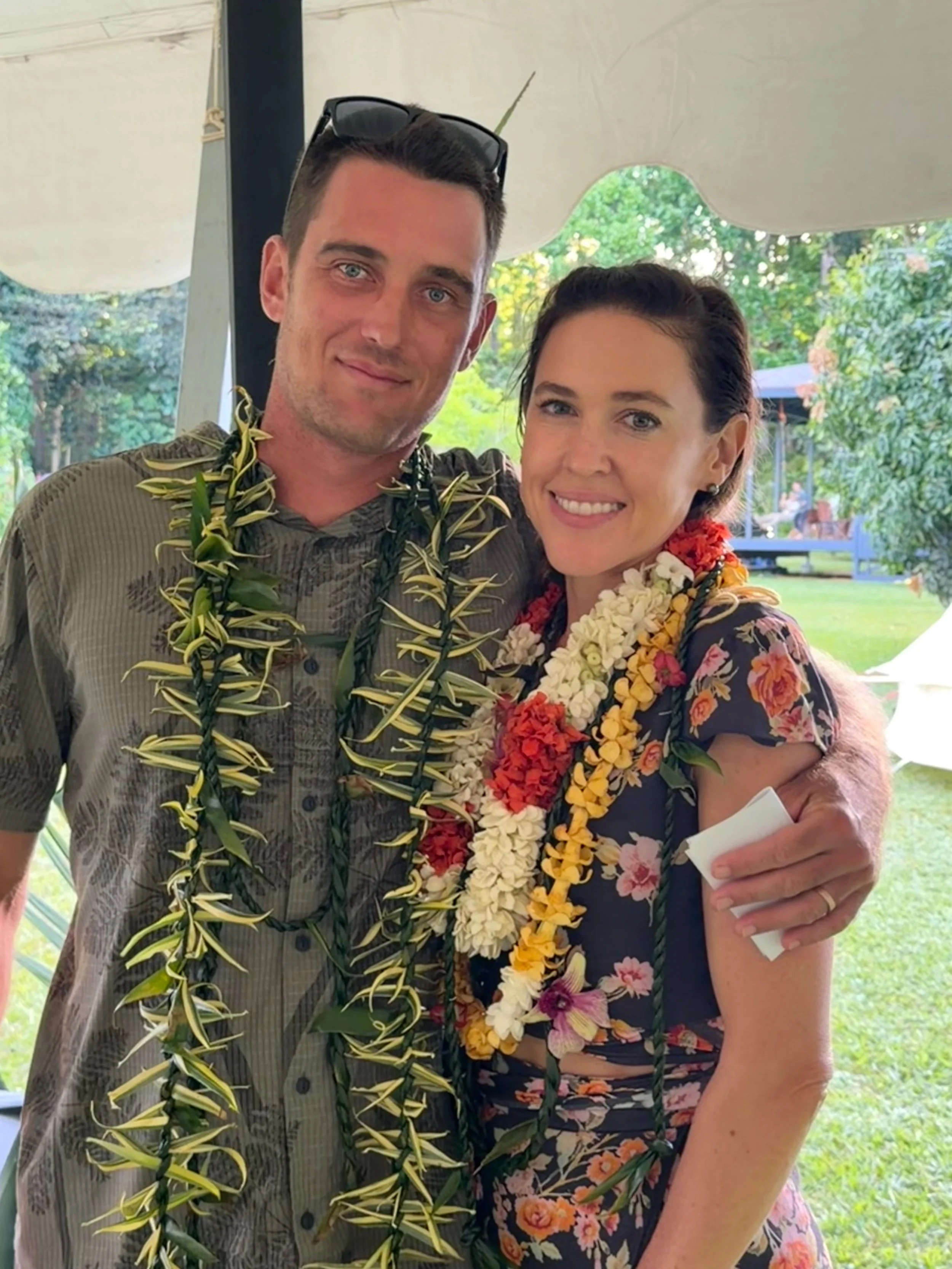
My husband and I, having spend half our lives together, thought we should celebrate the sacredness of it all.
Hierophany means the manifestation of the sacred in an otherwise ordinary thing. It could be the shaft of light through a window, the weight of a sleeping child on your shoulder, or even the laundry, lunches, or the ten-thousandth unremarkable Tuesday of chores and to-dos. Most people, when they first hear this, will think: "That sounds lovely, but I don't feel that.” I certainly didn't, for a very long time. The laundry was just the laundry, and mostly it made me want to scream.
Sitting on that lanai, I realized that while our own form of ordinary stretches us so thin sometimes I think we'll tear holes, the life we live has somehow turned out to be the most sacred thing I could have imagined. My life, my marriage, my family, the laundry and lunches and everything in between—my hierophany. The ordinary was the holiest thing all along.
"I have found the sacred in all of it," I wrote, "because you are in it. Because our remarkable kids are in it. This tribe of ours makes everything mean something."
I wasn't always here. Many years ago, I couldn't fathom how I could do it all—be a good mother and a career woman, keep the house, carry the responsibilities, manage chronic illness—and the weight of it made me angry at just about everything, and everyone. What I didn't understand then was how much energy I was hemorrhaging just by living in that state of low-grade fury and overwhelm. My circumstances weren't so different from today. What changed was my nervous system. When it finally relaxed enough to stop treating an ordinary Tuesday as a total emergency, I looked up and the same life I had been living—same lanai, the same family, the same impossible to-do list—looked completely different. The sacred had been there the whole time. I just hadn't been still enough to see it.
And now here I was, still living that full and sometimes chaotic life: running two companies, raising children on three tropical acres (which we are increasingly grateful to still afford), through health challenges and long seasons of exhaustion, and all the unremarkable Tuesdays neither of us will ever. But now I inhabit it in a way that has transformed into something I can only describe as deeper, more meaningful, richer, and more magical.
That is what hierophany does. It doesn't change life; it takes the same life and makes it more spectacular. And it was perhaps the biggest thing to heal my body of all—something no supplement protocol could ever replace.
I didn't arrive here easily. My former self—driven, fast-moving, always five steps ahead—would have been genuinely alarmed by this version of me tearing up on a porch over the sacredness of an ordinary life. The laundry, the lunches, the unremarkable Tuesday?! She would have yelled at me for giving up. And honestly, her demanding presence almost convinced me for a time that she wasn't wrong. So what changed?
Part of it was simply time—years of choices and new routines that, over time, wear a path that feels, on balance, like mine. Part of it was the painfully slow work of learning to regulate a nervous system that had spent years running hot, treating ordinary tasks like emergencies, treating stillness like a threat. (This work I credit in large part to committing to a program called DNRS—deliberate neural rewiring that I'll write about properly another time, but which I think of as the turning point.) Much of it was about stopping listening to the pressures of outside expectations, trying to dictate that success comes from schedules overflowing.
But a significant part of it —the part I rarely talk about because I am so rarely online to talk about anything —is that I stopped consuming the world at speed, and changed the entire pace at which I interacted with just about everything. I now prioritize what is important and understand what is equally important to set aside.
This is why I am almost never on social media. I come back occasionally, once a month if that, and every time I am reminded why I left. Not because the world online is without value (there is honestly so much great information there), but because something happens there that I suppose only certain substances like alcohol or drugs could compete with: I lose the thread of my own life. I start moving fast again, thinking fast, reacting fast. The quality of my attention shatters into a bazillion pieces. And for someone whose nervous system spent years unable to distinguish between real threat and perceived threat—living in a body already running an inflammatory current—that cost is always higher than any perceived benefit.
So I stepped back. Reading fact-based books about the realities of the world—Factfulness by Hans Rosling, Humankind by Rutger Bregman—that depicted, in numbers, what I saw in real life: the world is not nearly as bad as we're told. The gray smear lifted, and color came back. Turns out your perspective is a pretty powerful drug.
My new perspective showed me that I can still be ambitious and goal-oriented (don't worry, former me) while also being grounded, content, and getting the laundry done. I can have a family, career, be fulfilled, and still maintain remission. But let's be honest: with limited time, this takes significant prioritizing and cutting away the things that drain energy. Energy leaks, I call them. If you catalog your negative spirals, complaints, judgments, and milk-spilling cortisol spikes alone, you might be surprised how many hours are leaking away. Add in social media, doomscrolling, and the kind of griping conversations that eat up so much of social time, and you can start to see where I was able to easily trim the fat.
For those of us with sensitive dispositions, it can also look like cutting out things that are, well, good. When we have to prioritize and balance our have-tos with extras, sometimes we need seasons where we say goodbye to gardening or extra volunteering. Not forever, but with the (good) intentions that healing the soul will allow us to come back more ready than ever for the extras when time permits.
While cutting the energy vampires away, good and bad, I never really considered what would replace them. So what happened next was quite surprising.
In a new headspace (that wasn’t spinning and inflamed), I found myself starting to devour books about magic and Fae, dragons, and royals. This was not normal for me; I never really read fantasy. But suddenly, I got lost in the A Court of Thorns and Roses series and Throne of Glass, both by Sarah J. Maas. I know not everyone loves these books, and that is completely fine (I forgive you). But truth be told, something in those stories woke up a part of my spirit I hadn't heard from in years. The part that used to seek out fairies, that walked into a crystal shop and felt inexplicably at home, that looked at a forest and believed something was living in it beyond science.
It turns out that a nervous system no longer running on threat has room for wonder, and that wonder had been completely depleted from my fast-thinking, science-brain. Here it was, emerging.
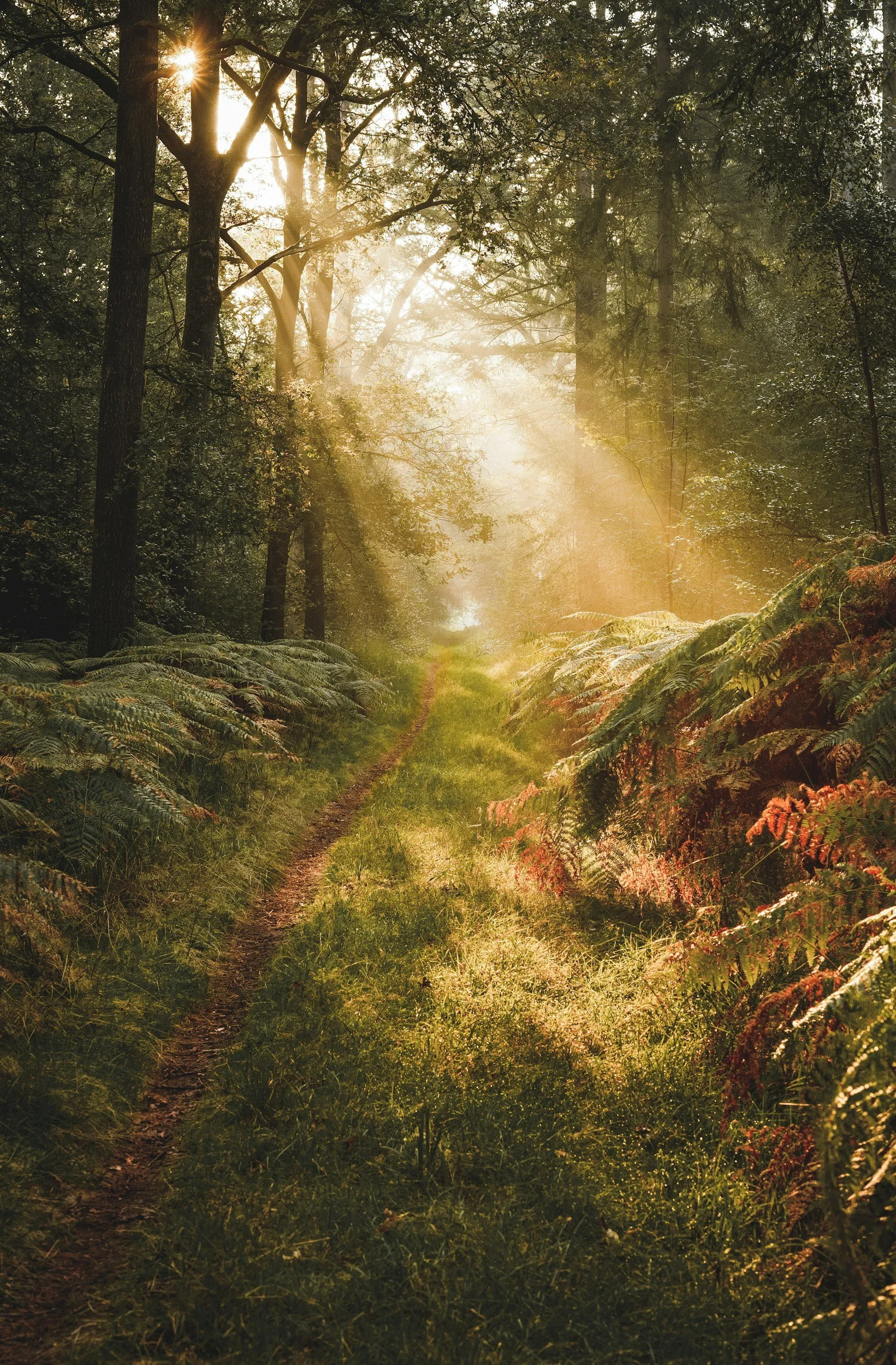
Around the same time, I started painting with my children whenever they sat down to do art. I am not an artist—badly, genuinely badly, I use the word "art" very generously—but I decided I wanted to learn to paint light streaming through leaves. The way sunlight hits a leaf in the shade, and the chlorophyll seems to glow from within.
I cannot do it justice on paper, and I'm sure those of you who actually paint are laughing that I chose such an advanced subject when I can barely sketch a stick figure. But something happened in trying: I became a person who looks for that light everywhere. On my morning runs, through the kitchen window, on the drive to school. On the forest edge at dusk, when the shadows come. I started pointing it out to my kids excitedly, and, bless their childhood spirits, they were just as amazed as I was.
That's when I understood the childlike part of my own spirit, the one who saw magic in ordinary things, was never gone, nor did my children have to lose theirs at some point. Perhaps our inner magic, the kind we know from childhood, just gets drowned out. All those cortisol spikes, brain spirals, all that urgency—for me, they had been occupying every available frequency. When I finally cleared enough of them, magic simply walked back into my life.
This, I've come to believe, is how hierophany becomes available to us again. Not because the world has changed, but because we have finally cleared enough space to see what was sacred all along. And the ability to find it—in a leaf glowing in afternoon shade, in a monarch butterfly, even in the laundry—is not just a lovely way to live. It's a signal that your nervous system has finally, blessedly, begun to heal.
I know this personally because I've felt both sides of it.
The first time I understood that the pace I was living might be more dangerous than anything I was eating was in my early twenties. I was burnt out, dealing with chronic health challenges, and carrying the very strange fact that at twenty-one years old, I had never once gotten my period. Doctors were flummoxed.
When I moved to Kauaʻi and stopped—truly stopped—the spinning stopped too. I cruised like a local, fell in love with a man who is now my husband, and got my period for the first time (yes at 21). My nervous system, it turned out, had been so chronically activated that it simply wouldn't consider reproducing. One month of real rest, and she remembered what safety felt like. I felt wholly healed.
Then life came roaring back. Societal and self-inflicted obligations kicked in, and cruising started to feel irresponsible…something I could no longer afford. I picked up the pace, and my nervous system, obedient and exhausted, followed me right back. Always on, going zero to sixty(!), cortisol spiking with every spilled milk(!), heart rate climbing just to answer emails! My body kept a running tally of it all, and the list was long.
My period remained, but suddenly, endometriosis was tagging along.
The chronic activation followed me into every squeezed season of life, and parenthood most of all. After my children were born, I didn't know how to simply be a present mother—I wanted to work, accomplish, produce, and get things done. As any parent will contend, there is a lot. to. do. And with all there was to do, my body did not feel safe slowing down to see anything in my ordinary that resembled enchantment. The sacred was there—it’s always there—but I was moving too fast and burning too hot to feel any of it.
What I didn't understand then was that the urgency itself was making me sick. Not just the endometriosis. And the whole constellation of things that followed—the recurring SIBO, MCAS, joint pain, allergies—followed reliably, every time I climbed back into that state of chronic activation. Meanwhile, I kept looking for the right protocol to fix what the wrong pace had created. It took me an embarrassingly long time (and, again, a program called DNRS) to understand that those two things were related.
Finally, I did something that felt deeply uncomfortable: let go of the cortisol addiction. It happened reluctantly at first, then with something close to relief. I stepped out of the urgency I'd been living inside for decades and stayed out long enough for my body to remember what safety felt like. I stopped rushing through ninety percent of my days in order to enjoy the last ten. The shift was no dramatic 30-day challenge…it was humbling and slow. For a time, I felt truly exhausted (who knew urgency, cortisol, and activation could stimulate you like caffeine?), but after a while, my real, true, and pure self came back. I liked her.
I understand now what I didn't then: sympathetic dominance is where inflammation lives. Parasympathetic is where healing lives. The ability to return easily to that softer state—to cruise, to potter, to let the evening just be an evening—is not a luxury or a personality type. It is human physiology. And for those of us living with endometriosis, trauma, chronic stress, and the whole tangled constellation of conditions that cluster in this community, learning to find that gear again is not optional. It is, I would argue, the work.
Of course, not the only work. Nutrition matters, and sleep, and dysbiosis, and all the things I write about in my deep dives. I’m writing a new book about blood sugar and endo and the connections are amazing. But beneath all of it, undergirding everything, is the question of how you are moving through your days. Whether adrenaline is driving the car, or whether you have learned to let it rest. Addiction to cortisol will have us reaching for social media again, reading the worst comment sections, being angry at strangers, and reading the sensational news like it’s real life. It had me stuck in my own realm of judgment, negativity, and compulsive behaviors that never got me anywhere. It can stimulate you, addict you, even somehow convince you to not to do the things that will make your life better.
And oddly enough, letting go of it all was …. hard. Harder than I thought. But as it turns out, that foundation alone will be the reason the inflammation subsides, returns, or simply stays. No matter how many expensive antioxidants you take.
Very clearly, I myself am still learning. Not many of us were taught how to stay regulated in an ocean of responsibilities ready to vaporize us, so we must have grace for ourselves and others as we learn. Life is full, sometimes hard, and often surprising. But now, after much practice, I catch myself when I start to rush, worry, or ruminate. I now know that the ruminating itself is the dysregulation, not the thing I'm ruminating about.
The light is coming up on the other side of the property as I finish writing this, shining directly onto the forest instead of behind it. I wake early to work, stealing a few hours before the kids are up. In a few minutes, I will head into the kitchen. The children will need things, there will be dishes and school drop-off, after that, there will be work, emails, accounting, and chores, more meals, and some laundry. I will squeeze in exercise because it matters. And tomorrow will ask something of me I cannot yet predict.
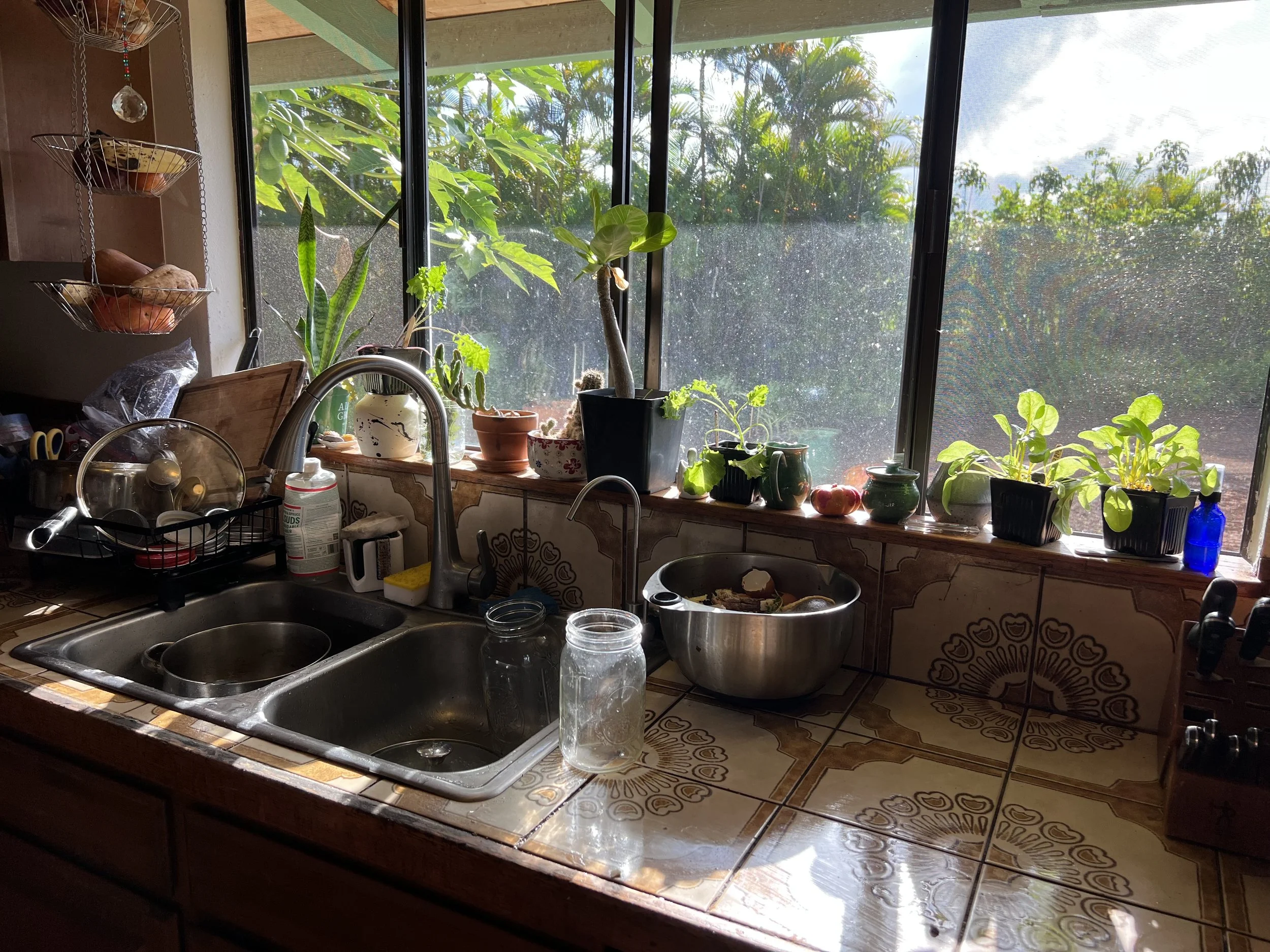
My “working” kitchen is nothing Pinterest-perfect, but it shares the story of our lives and offers us some beautiful, enchanting light at times.
But this evening, there will be monarch butterflies at the tree down the path, tag in the field, or a stream in the forest that has been running all day, whether anyone was there to hear it or not. We will eat dinner on the porch, and I will infuse love into my daily tasks as if it were the altar to which I lay my life. I won't have time for infrared saunas or Epsom salt soaks—and honestly, I don't need them anymore. Trying to fit in yet another healing methodology would only pull me back into the very mode of vigilance I've spent years learning to leave behind.
I used to think remission would demand something else…. maybe perhaps a few million dollars so I could stop working and just take care of my body. But in all honesty, my days probably look similar to yours; days spent doing the things that must be done. The same things, really, that used to sink me back when I was full of chronic illness and the earth-shattering hypervigilance that came with it: the chores and responsibilities on repeat.
And while I have definitely re-prioritized my life as it needs to be during this season of young kids and family life (a very specific season geared to drown most of us if we’re not proactive), the difference now is not the tasks; it never was. It's that the milk spills, and I don't spike. It’s that I can respond gently instead of with knee-jerk reactions. The ordinary Tuesday doesn't feel like a threat anymore. And in that small, perhaps boring shift—one that no protocol can manufacture and no supplement can replicate—the sacred finally had room to move in. My life became my hierophany, and the hierophany keeps chronic illness at bay.
I still do laundry, raise kids, and run the companies. But now I see the light in the leaves.
Whatever we must do, the way we choose to do it matters. For me, it’s finding the sacred in the ordinary, the magic in the mundane, the joy in the dark, and the light in the duller parts of life. For me, this is what remission looks like. Not a fancy protocol, not a perfect nirvana of peace and prosperity.
Just an ordinary (and very full) life, carefully tended. Here I stay.
I would love to hear from you — what are you noticing lately? What small thing has stopped you mid-sentence, mid-bite, mid-thought? Write to me. I am much better at email than Instagram.
Until next time, may the light stay out a little longer for you too.
With love from Kauaʻi, Katie